
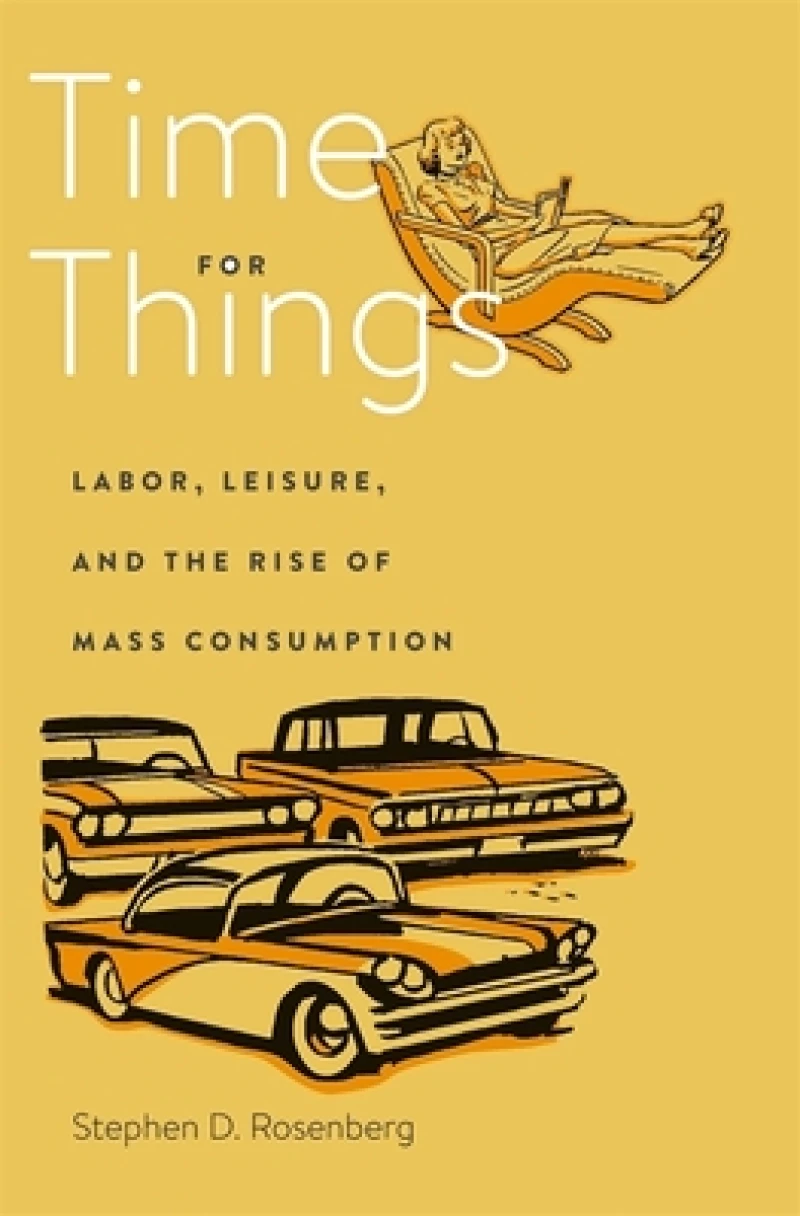
Time for Things – Labor, Leisure, and the Rise of Mass Consumption : Labor, Leisure, and the Rise of Mass Consumption
Book Details
Format
Hardback or Cased Book
ISBN-10
0674979516
ISBN-13
9780674979512
Publisher
Harvard University Press
Imprint
Harvard University Press
Country of Manufacture
US
Country of Publication
GB
Publication Date
Jan 1st, 2021
Print length
368 Pages
Weight
668 grams
Dimensions
24.40 x 16.50 x 3.30 cms
Product Classification:
Social and ethical issuesSocial issues & processesSocial theoryPopular economicsEconomic history
Ksh 8,100.00
Werezi Extended Catalogue
Delivery in 14 days
1 copies in stock
Delivery Location
Delivery fee: Select location
Delivery in 14 days
Secure
Quality
Fast
Economists say there is a limit to what we gain by buying consumer goods. Americans say they want to work less. Yet we continue toiling away and use the proceeds to buy, buy, buy. Why? Stephen Rosenberg offers a novel theory, arguing that workers have learned to treat goods as stores of potential free time, legitimating endless wage work.
Modern life is full of stuff yet bereft of time. An economic sociologist offers an ingenious explanation for why, over the past seventy-five years, Americans have come to prefer consumption to leisure. Productivity has increased steadily since the mid-twentieth century, yet Americans today work roughly as much as they did then: forty hours per week. We have witnessed, during this same period, relentless growth in consumption. This pattern represents a striking departure from the preceding century, when working hours fell precipitously. It also contradicts standard economic theory, which tells us that increasing consumption yields diminishing marginal utility, and empirical research, which shows that work is a significant source of discontent. So why do we continue to trade our time for more stuff?Time for Things offers a novel explanation for this puzzle. Stephen Rosenberg argues that, during the twentieth century, workers began to construe consumer goods as stores of potential free time to rationalize the exchange of their labor for a wage. For example, when a worker exchanges their labor for an automobile, they acquire a duration of free activity that can be held in reserve, counterbalancing the unfree activity represented by work. This understanding of commodities as repositories of hypothetical utility was made possible, Rosenberg suggests, by the standardization of durable consumer goods, as well as warranties, brands, and product-testing, which assured wage earners that the goods they purchased would be of consistent, measurable quality. This theory clarifies perplexing aspects of behavior under industrial capitalism—the urgency to spend earnings on things, the preference to own rather than rent consumer goods—as well as a variety of historical developments, including the coincident rise of mass consumption and the legitimation of wage labor.
Get Time for Things – Labor, Leisure, and the Rise of Mass Consumption by at the best price and quality guaranteed only at Werezi Africa's largest book ecommerce store. The book was published by Harvard University Press and it has pages.

