
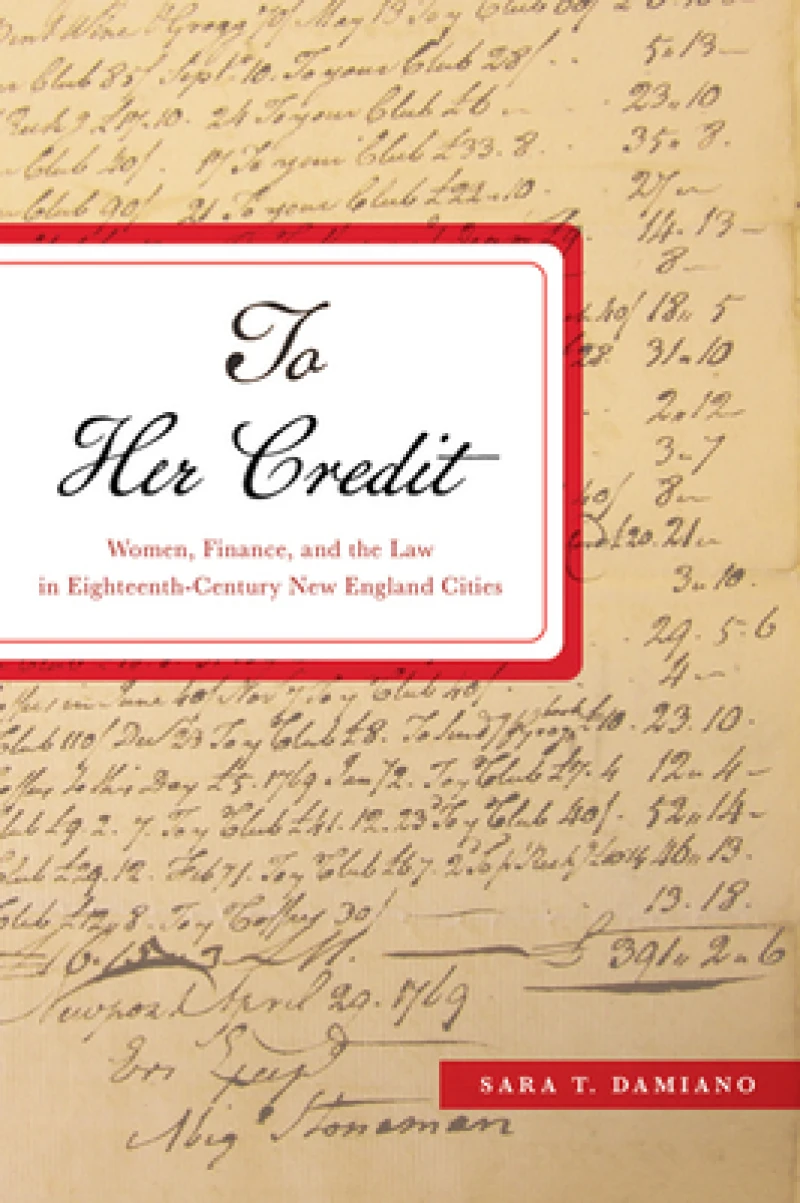
To Her Credit : Women, Finance, and the Law in Eighteenth-Century New England Cities
Book Details
Format
Hardback or Cased Book
ISBN-10
1421440555
ISBN-13
9781421440552
Publisher
Johns Hopkins University Press
Imprint
Johns Hopkins University Press
Country of Manufacture
US
Country of Publication
GB
Publication Date
Jun 15th, 2021
Print length
312 Pages
Weight
568 grams
Dimensions
16.00 x 23.70 x 3.10 cms
Product Classification:
History of the AmericasGender studies, gender groups
Ksh 8,200.00
Werezi Extended Catalogue
0 in stock
Delivery Location
Delivery fee: Select location
Secure
Quality
Fast
A transformative look at colonial women's pivotal roles as lenders and debtors in shaping the economic and legal systems of Newport and Boston. Winner of the Berkshire Women Historians Book Prize by the Berkshire Conference of Women HistoriansIn colonial Boston and Newport, personal credit relationships were a cornerstone of economic networks. During the eighteenth century, the pace of market exchange quickened and debt cases swelled the dockets of county courts, institutions that became ever more central to enforcing financial obligations. At the same time, seafaring and military service drew men away from home, some never to return. The absences of male household heads during this era of economic transition forced New Englanders to evaluate a pressing question: Who would establish and manage consequential financial relationships?In To Her Credit, Sara T. Damiano uncovers free women's centrality to the interrelated worlds of eighteenth-century finance and law. Focusing on everyday life in Boston, Massachusetts, and Newport, Rhode Island—two of the busiest port cities of this period—Damiano argues that colonial women's skilled labor actively facilitated the growth of Atlantic ports and their legal systems. Mining vast troves of court records, Damiano reveals that married and unmarried women of all social classes forged new paths through the complexities of credit and debt, stabilizing credit networks amid demographic and economic turmoil. In turn, urban women mobilized sophisticated skills and strategies as borrowers, lenders, litigants, and witnesses. Highlighting the often-unrecognized malleability of early American social hierarchies, the book shows how indebtedness intensified women's vulnerability, while acting as creditors, clients, or witnesses enabled women to exercise significant power over men. Yet by the late eighteenth century, class differentiation began to mark finance and the law as masculine realms, obscuring women's contributions to the very institutions they helped to create. The first book to systematically reconstruct the centrality of women's labor to eighteenth-century personal credit relationships, To Her Credit will be an eye-opening work for economic historians, legal historians, and anyone interested in the early history of New England.
Get To Her Credit by at the best price and quality guaranteed only at Werezi Africa's largest book ecommerce store. The book was published by Johns Hopkins University Press and it has pages.

