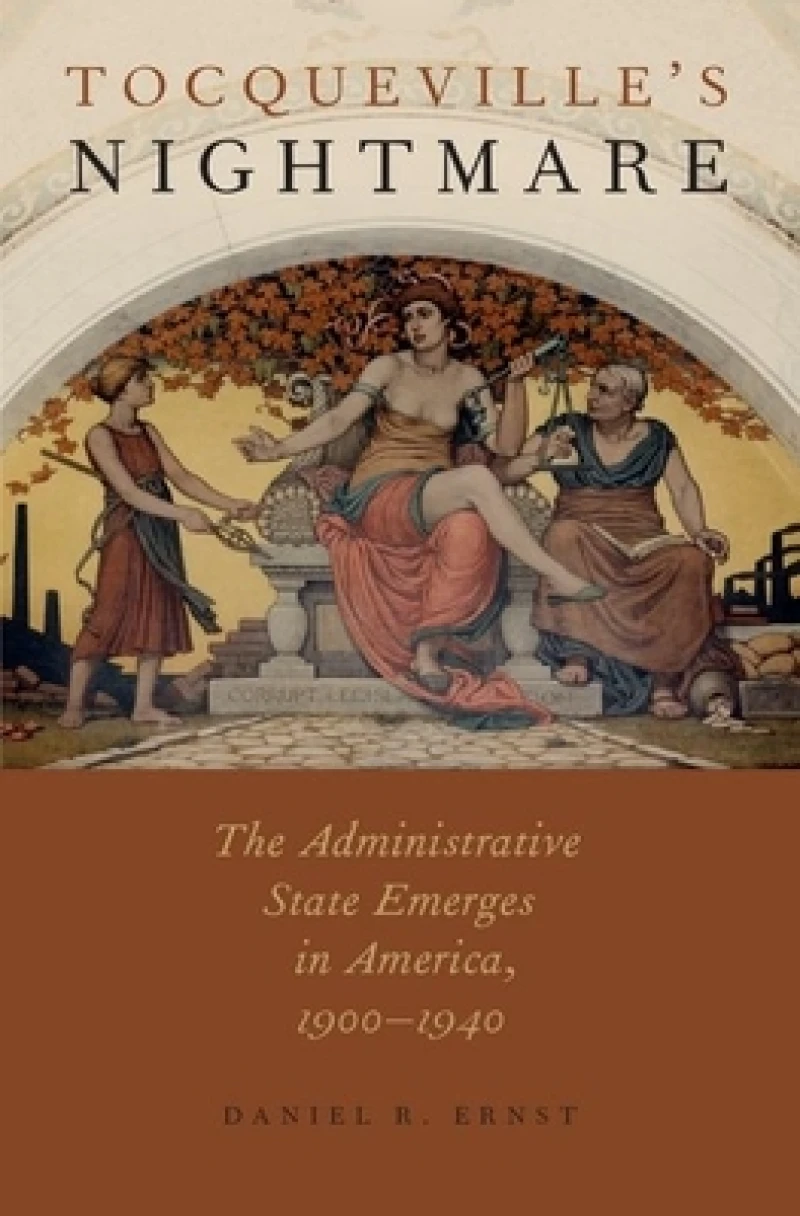
Tocqueville's Nightmare : The Administrative State Emerges in America, 1900-1940
Book Details
Format
Hardback or Cased Book
ISBN-10
0199920869
ISBN-13
9780199920860
Publisher
Oxford University Press Inc
Imprint
Oxford University Press Inc
Country of Manufacture
GB
Country of Publication
GB
Publication Date
May 15th, 2014
Print length
240 Pages
Weight
450 grams
Dimensions
24.40 x 16.40 x 2.20 cms
Product Classification:
History of the AmericasPolitical economyLegal historyConstitutional & administrative law
Ksh 10,450.00
Manufactured on Demand
0 in stock
Delivery Location
Delivery fee: Select location
Secure
Quality
Fast
Between 1900 and 1940, Americans confronted a puzzle: how could administrative agencies address the nation's troubles without violating individual liberty? From the close reasoning of judges, the self-interest of lawyers, and the machinations of politicians, an answer emerged.
In the 1830s, the French aristocrat Alexis de Tocqueville wrote that ''insufferable despotism'' would prevail if America ever acquired a national administrative state. Today''s Tea Partiers evidently believe that, after a great wrong turn in the early twentieth century, Tocqueville''s nightmare has come true. In those years, it seems, a group of radicals, seduced by alien ideologies, created vast bureaucracies that continue to trample on individual freedom. Tocqueville''s Nightmare, shows, to the contrary, that the nation''s best corporate lawyers were among the creators of ''commission government,'' that supporters were more interested in purging government of corruption than creating a socialist utopia, and that the principles of individual rights, limited government, and due process were designed into the administrative state. Far from following ''un-American'' models, American statebuilders rejected the leading European scheme for constraining government, the Rechtsstaat, a state of rules. Instead, they looked to an Anglo-American tradition that equated the rule of law with the rule of courts and counted on judges to review the bases for administrators'' decisions aggressively. Soon, however, even judges realized that strict judicial review shifted to generalist courts decisions best left to experts. The most masterful judges, including Charles Evans Hughes, Chief Justice of the United States from 1930 to 1941, ultimately decided that a ''day in court'' was unnecessary if individuals had already had a ''day in commission'' where the fundamentals of due process and fair play prevailed. Not only did this procedural notion of the rule of law solve the judges'' puzzle of reconciling bureaucracy and freedom; it also assured lawyers that their expertise in the ways of the courts would remain valuable and professional politicians that presidents would not use administratively distributed largess as an independent source of political power.
Get Tocqueville's Nightmare by at the best price and quality guaranteed only at Werezi Africa's largest book ecommerce store. The book was published by Oxford University Press Inc and it has pages.