
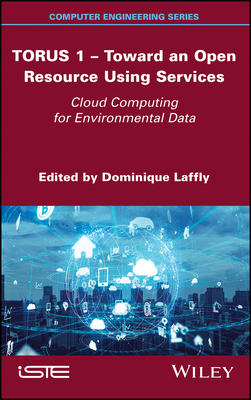
TORUS 1 – Toward an Open Resource Using Services – Cloud Computing for Environmental Data : Cloud Computing for Environmental Data
Book Details
Format
Hardback
ISBN-10
1786305992
ISBN-13
9781786305992
Publisher
ISTE Ltd and John Wiley & Sons Inc
Imprint
ISTE Ltd and John Wiley & Sons Inc
Country of Manufacture
US
Country of Publication
GB
Publication Date
Mar 13th, 2020
Print length
352 Pages
Weight
612 grams
Dimensions
22.80 x 15.20 x 2.20 cms
Product Classification:
Electronics engineeringComputer science
KSh 25,000.00
Currently unavailable
0 in stock
Delivery Location
Delivery fee: Select location
Secure
Quality
Fast
This book, presented in three volumes, examines ?environmental? disciplines in relation to major players in contemporary science: Big Data, artificial intelligence and cloud computing. Today, there is a real sense of urgency regarding the evolution of computer technology, the ever-increasing volume of data, threats to our climate and the sustainable development of our planet. As such, we need to reduce technology just as much as we need to bridge the global socio-economic gap between the North and South; between universal free access to data (open data) and free software (open source). In this book, we pay particular attention to certain environmental subjects, in order to enrich our understanding of cloud computing. These subjects are: erosion; urban air pollution and atmospheric pollution in Southeast Asia; melting permafrost (causing the accelerated release of soil organic carbon in the atmosphere); alert systems of environmental hazards (such as forest fires, prospective modeling of socio-spatial practices and land use); and web fountains of geographical data. Finally, this book asks the question: in order to find a pattern in the data, how do we move from a traditional computing model-based world to pure mathematical research? After thorough examination of this topic, we conclude that this goal is both transdisciplinary and achievable.
Get TORUS 1 – Toward an Open Resource Using Services – Cloud Computing for Environmental Data by Dominique Laffly at the best price and quality guaranteed only at Werezi Africa's largest book ecommerce store. The book was published by ISTE Ltd and John Wiley & Sons Inc and it has 352 pages.
Customers Who Bought This Also Bought

Lectures On White Noise Functionals
KSh 21,600.00

Ultra-Wideband Positioning Systems
KSh 12,050.00

Electronic Wastes
KSh 24,550.00

Electronic Wastes
KSh 24,550.00

Minimizing Uncertainty in the Design of Technical Systems
KSh 22,500.00

Advanced Automotive Electricity and Electronics
KSh 12,900.00

Formal Description Techniques and Protocol Specification, Testing and Verification
KSh 32,400.00

A Mind at Play
KSh 3,600.00

Renewable-Focused Operation and Control of Contemporary Power Systems
KSh 17,100.00

Building Your Own Electronics Lab
KSh 9,000.00

Synchronous Generators
KSh 30,950.00

Emissive Materials - Nanomaterials
KSh 45,000.00
