
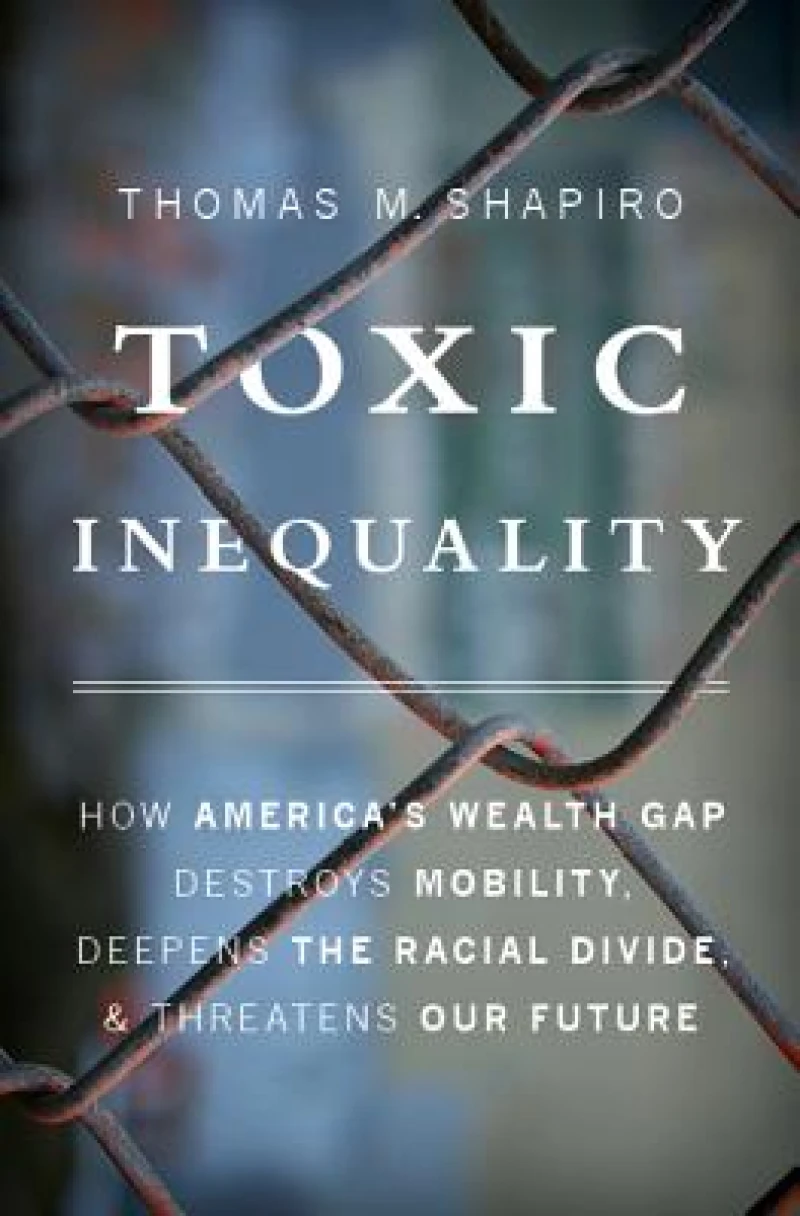
Toxic Inequality : How America's Wealth Gap Destroys Mobility, Deepens the Racial Divide, and Threatens Our Future
Book Details
Format
Hardback or Cased Book
ISBN-10
0465046932
ISBN-13
9780465046935
Publisher
Basic Books
Imprint
Basic Books
Country of Manufacture
US
Country of Publication
GB
Publication Date
Apr 27th, 2017
Print length
288 Pages
Weight
412 grams
Dimensions
15.00 x 21.90 x 3.00 cms
Ksh 5,000.00
Werezi Extended Catalogue
0 in stock
Delivery Location
Delivery fee: Select location
Secure
Quality
Fast
From a leading authority on race and public policy, a deeply researched account of how families rise and fall today
From a leading authority on race and public policy, a deeply researched account of how families rise and fall today
Since the Great Recession, most Americans'' standard of living has stagnated or declined. Economic inequality is at historic highs. But inequality''s impact differs by race; African Americans'' net wealth is just a tenth that of white Americans, and over recent decades, white families have accumulated wealth at three times the rate of black families. In our increasingly diverse nation, sociologist Thomas M. Shapiro argues, wealth disparities must be understood in tandem with racial inequities -- a dangerous combination he terms "toxic inequality."
In Toxic Inequality, Shapiro reveals how these forces combine to trap families in place. Following nearly two hundred families of different races and income levels over a period of twelve years, Shapiro''s research vividly documents the recession''s toll on parents and children, the ways families use assets to manage crises and create opportunities, and the real reasons some families build wealth while others struggle in poverty. The structure of our neighborhoods, workplaces, and tax code-much more than individual choices-push some forward and hold others back. A lack of assets, far more common in families of color, can often ruin parents'' careful plans for themselves and their children.
Toxic inequality may seem inexorable, but it is not inevitable. America''s growing wealth gap and its yawning racial divide have been forged by history and preserved by policy, and only bold, race-conscious reforms can move us toward a more just society.
"Everyone concerned about the toxic effects of inequality must read this book." -- Robert B. Reich
"This is one of the most thought-provoking books I have read on economic inequality in the US." -- William Julius Wilson
Since the Great Recession, most Americans'' standard of living has stagnated or declined. Economic inequality is at historic highs. But inequality''s impact differs by race; African Americans'' net wealth is just a tenth that of white Americans, and over recent decades, white families have accumulated wealth at three times the rate of black families. In our increasingly diverse nation, sociologist Thomas M. Shapiro argues, wealth disparities must be understood in tandem with racial inequities -- a dangerous combination he terms "toxic inequality."
In Toxic Inequality, Shapiro reveals how these forces combine to trap families in place. Following nearly two hundred families of different races and income levels over a period of twelve years, Shapiro''s research vividly documents the recession''s toll on parents and children, the ways families use assets to manage crises and create opportunities, and the real reasons some families build wealth while others struggle in poverty. The structure of our neighborhoods, workplaces, and tax code-much more than individual choices-push some forward and hold others back. A lack of assets, far more common in families of color, can often ruin parents'' careful plans for themselves and their children.
Toxic inequality may seem inexorable, but it is not inevitable. America''s growing wealth gap and its yawning racial divide have been forged by history and preserved by policy, and only bold, race-conscious reforms can move us toward a more just society.
"Everyone concerned about the toxic effects of inequality must read this book." -- Robert B. Reich
"This is one of the most thought-provoking books I have read on economic inequality in the US." -- William Julius Wilson
Get Toxic Inequality by at the best price and quality guaranteed only at Werezi Africa's largest book ecommerce store. The book was published by Basic Books and it has pages.

