
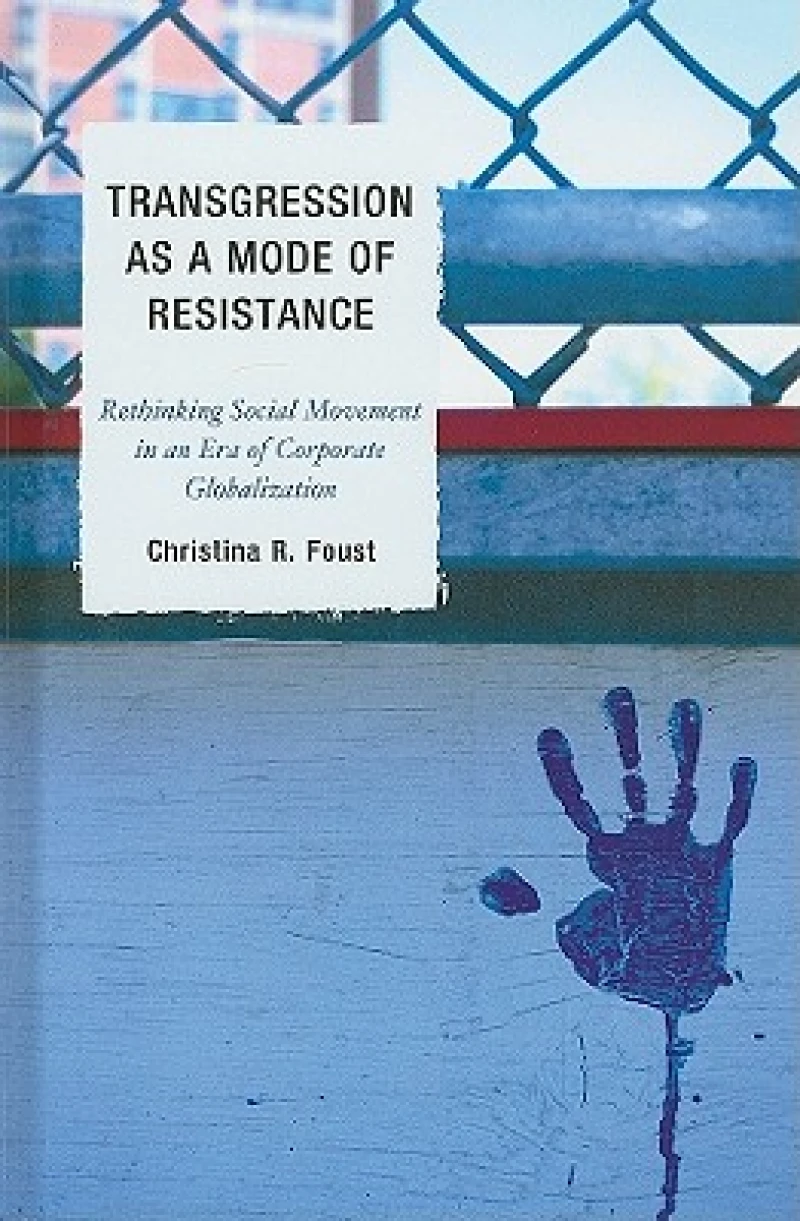
Transgression as a Mode of Resistance : Rethinking Social Movement in an Era of Corporate Globalization
Book Details
Format
Hardback or Cased Book
ISBN-10
0739143352
ISBN-13
9780739143353
Publisher
Bloomsbury Publishing Plc
Imprint
Lexington Books
Country of Manufacture
GB
Country of Publication
GB
Publication Date
Jun 22nd, 2010
Print length
256 Pages
Weight
553 grams
Dimensions
24.10 x 16.20 x 2.20 cms
Product Classification:
GlobalizationPolitical activism
Ksh 21,300.00
Manufactured on Demand
0 in stock
Delivery Location
Delivery fee: Select location
Secure
Quality
Fast
Since industrialization, two major theoretical perspectives have accompanied the vibrant practice of social change. The first, hegemony, emerged as a less deterministic route to revolution from Marxist theory, and forms the common sense of social movement today. Within hegemonic resistance, rhetoric links issues, ideas, and identities to form a recognizable collective agent, whose aim is to transform the status quo into its vision of the world. The second major mode of resistance, transgression, grows from anarchist and autonomous resistance to capitalism. Transgression attempts to free individuals' uniqueness and creative power by deconstructing authority and explicating the body in resistance. Transgression as a Mode of Resistance: Rethinking Social Movement in an Era of Corporate Globalization provides the conceptual mapping for scholars, students, and practitioners to participate in the growing debate between these rich and powerful forces of social change. Through a broad perspective on philosophy and history, Christina R. Foust demonstrates that hegemony and transgression are sometimes conflicting, oftentimes inter-related practices. She responds to critics who believe that without a social change agent, resistance appears baseless and naive; without a representational economy to cohere and express common interests, social movement is impossible. Through alternative social relationships and political performances, transgressive resistors may reinvent daily life.
Since industrialization, two major theoretical perspectives have accompanied the vibrant practice of social change. The first, hegemony, emerged as a less deterministic route to revolution from Marxist theory, and forms the common sense of social movement today. Within hegemonic resistance, rhetoric links issues, ideas, and identities to form a recognizable collective agent, whose aim is to transform the status quo into its vision of the world. The second major mode of resistance, transgression, grows from anarchist and autonomous resistance to capitalism. Transgression attempts to free individuals'' uniqueness and creative power by deconstructing authority and explicating the body in resistance. Transgression as a Mode of Resistance: Rethinking Social Movement in an Era of Corporate Globalization provides the conceptual mapping for scholars, students, and practitioners to participate in the growing debate between these rich and powerful forces of social change. Through a broad perspective on philosophy and history, Christina R. Foust demonstrates that hegemony and transgression are sometimes conflicting, oftentimes inter-related practices. She responds to critics who believe that without a social change agent, resistance appears baseless and naïve; without a representational economy to cohere and express common interests, social movement is impossible. Through alternative social relationships and political performances, transgressive resistors may reinvent daily life.
Get Transgression as a Mode of Resistance by at the best price and quality guaranteed only at Werezi Africa's largest book ecommerce store. The book was published by Bloomsbury Publishing Plc and it has pages.

