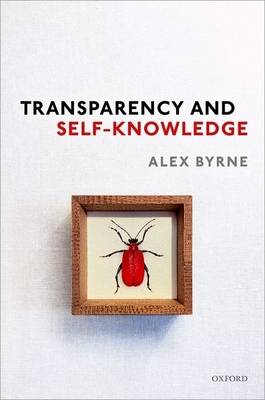
Transparency and Self-Knowledge
by
Alex Byrne
Book Details
Format
Paperback / softback
ISBN-10
0192868993
ISBN-13
9780192868992
Publisher
Oxford University Press
Imprint
Oxford University Press
Country of Manufacture
GB
Country of Publication
GB
Publication Date
Jun 23rd, 2022
Print length
240 Pages
Weight
384 grams
Dimensions
23.10 x 15.70 x 1.40 cms
KSh 5,000.00
Temporarily out of stock, due soon
0 in stock
Delivery Location
Delivery fee: Select location
Secure
Quality
Fast
You know what someone else is thinking and feeling by observing them. But how do you know what you are thinking and feeling? This is the problem of self-knowledge: Alex Byrne tries to solve it. The idea is that you know this not by taking a special kind of look at your own mind, but by an inference from a premise about your environment.
Alex Byrne sets out and defends a theory of self-knowledge-knowledge of one''s mental states. Inspired by Gareth Evans'' discussion of self-knowledge in his The Varieties of Reference, the basic idea is that one comes to know that one is in a mental state M by an inference from a worldly or environmental premise to the conclusion that one is in M. (Typically the worldly premise will not be about anything mental.) The mind, on this account, is ''transparent'': self-knowledge is achieved by an ''outward glance'' at the corresponding tract of the world, not by an ''inward glance'' at one''s own mind. Belief is the clearest case, with the inference being from ''p'' to ''I believe that p''. One serious problem with this idea is that the inference seems terrible, because ''p'' is at best very weak evidence that one believes that p. Another is that the idea seems not to generalize. For example, what is the worldly premise corresponding to ''I intend to do this'', or ''I feel a pain''? Byrne argues that both problems can be solved, and explains how the account covers perception, sensation, desire, intention, emotion, memory, imagination, and thought. The result is a unified theory of self-knowledge that explains the epistemic security of beliefs about one''s mental states (privileged access), as well as the fact that one has a special first-person way of knowing about one''s mental states (peculiar access).
Get Transparency and Self-Knowledge by Alex Byrne at the best price and quality guaranteed only at Werezi Africa's largest book ecommerce store. The book was published by Oxford University Press and it has 240 pages.
Customers Who Bought This Also Bought

A Treatise of Human Nature
KSh 2,700.00
Critique of Pure Reason
KSh 3,400.00

Sensuous Knowledge
KSh 4,500.00

Critique of Pure Reason, Abridged
KSh 3,600.00
Sharing Thoughts
KSh 17,000.00

The Critique of Pure Reason
KSh 6,450.00

Critique of Pure Reason
KSh 7,250.00
An Inquiry Into Meaning and Truth
KSh 3,750.00
Intelligence and Spirit
KSh 5,750.00
The Social Construction of What?
KSh 5,200.00

Discourse on Method and Related Writings
KSh 2,000.00
Beyond Good and Evil
KSh 2,000.00