
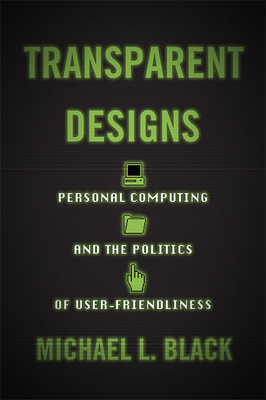
Transparent Designs : Personal Computing and the Politics of User-Friendliness
Book Details
Delivery Location
Delivery fee: Select location
This fascinating cultural history of the personal computer explains how user-friendly design allows tech companies to build systems that we cannot understand.
Modern personal computers are easy to use, and their welcoming, user-friendly interfaces encourage us to see them as designed for our individual benefit. Rarely, however, do these interfaces invite us to consider how our individual uses support the broader political and economic strategies of their designers.
In Transparent Designs, Michael L. Black revisits early debates from hobbyist newsletters, computing magazines, user manuals, and advertisements about how personal computers could be seen as usable and useful by the average person. Black examines how early personal computers from the Tandy TRS-80 and Commodore PET to the IBM PC and Apple Macintosh were marketed to an American public that was high on the bold promises of the computing revolution but also skeptical about their ability to participate in it. Through this careful archival study, he shows how many of the foundational principles of usability theory were shaped through disagreements over the languages and business strategies developed in response to this skepticism. In short, this book asks us to consider the consequences of a computational culture that is based on the assumption that the average person does not need to know anything about the internal operations of the computers we''ve come to depend on for everything.
Expanding our definition of usability, Transparent Designs examines how popular and technical rhetoric shapes user expectations about what counts as usable and useful as much as or even more so than hardware and software interfaces. Offering a fresh look at the first decade of personal computing, Black highlights how the concept of usability has been leveraged historically to smooth over conflicts between the rhetoric of computing and its material experience. Readers interested in vintage computing, the history of technology, digital rhetoric, or American culture will be fascinated in this book.
Get Transparent Designs by Michael L. Black at the best price and quality guaranteed only at Werezi Africa's largest book ecommerce store. The book was published by Johns Hopkins University Press and it has 280 pages.
Customers Who Bought This Also Bought
The Sovereign Individual
KSh 3,600.00
Message
KSh 3,400.00
Covering Islam
KSh 2,350.00

Stranger Faces
KSh 2,500.00

Careless People
KSh 2,000.00
Careless People
KSh 3,950.00

Medium is the Massage
KSh 2,000.00

Let Me Tell You What I Mean
KSh 2,000.00

Manufacturing Consent
KSh 2,350.00
A Web of Our Own Making
KSh 4,650.00
Understanding Media
KSh 5,750.00

Chokepoint Capitalism
KSh 2,000.00
