
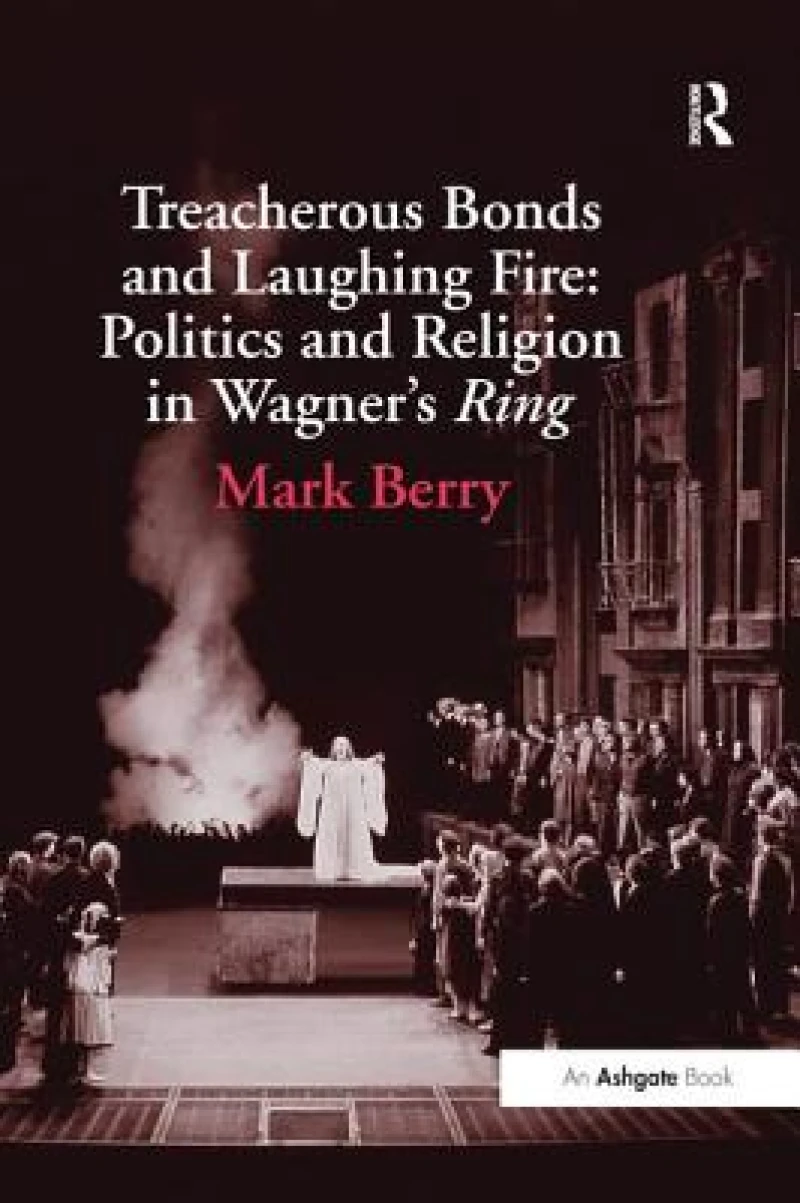
Treacherous Bonds and Laughing Fire: Politics and Religion in Wagner's Ring
by
Mark Berry
Book Details
Format
Paperback / Softback
ISBN-10
1138248606
ISBN-13
9781138248601
Publisher
Taylor & Francis Ltd
Imprint
Routledge
Country of Manufacture
GB
Country of Publication
GB
Publication Date
Sep 9th, 2016
Print length
304 Pages
Weight
466 grams
Dimensions
15.60 x 23.30 x 2.30 cms
Product Classification:
Classical music (c 1750 to c 1830)OperaHistory of ideas
Ksh 10,100.00
Werezi Extended Catalogue
0 in stock
Delivery Location
Delivery fee: Select location
Secure
Quality
Fast
Mark Berry explores the political and religious ideas expounded in Wagner’s Ring through close attention to the text and drama, the multifarious intellectual influences upon the composer during the work’s lengthy gestation and composition, and the wealth of Wagner source material.
Mark Berry explores the political and religious ideas expounded in Wagner''s Ring through close attention to the text and drama, the multifarious intellectual influences upon the composer during the work''s lengthy gestation and composition, and the wealth of Wagner source material. Many of his writings are explicitly political in their concerns, for Wagner was emphatically not a revolutionary solely for the sake of art. Yet it would be misleading to see even the most ''political'' tracts as somehow divorced from the aesthetic realm; Wagner''s radical challenge to liberal-democratic politics makes no such distinction. This book considers Wagner''s treatment of various worlds: nature, politics, economics, and metaphysics, in order to explain just how radical that challenge is. Classical interpretations have tended to opt either for an ''optimistic'' view of the Ring, centred upon the influence of Young Hegelian thought - in particular the philosophy of Ludwig Feuerbach - and Wagner''s concomitant revolutionary politics, or for the ''pessimistic'' option, removing the disillusioned Wagner-in-Swiss-exile from the political sphere and stressing the undoubtedly important role of Arthur Schopenhauer. Such an ''either-or'' approach seriously misrepresents not only Wagner''s compositional method but also his intellectual method. It also sidelines inconvenient aspects of the dramas that fail to ''fit'' whichever interpretation is selected. Wagner''s tendency is not progressively to recant previous ''errors'' in his oeuvre. Radical ideas are not completely replaced by a Schopenhauerian world-view, however loudly the composer might come to trumpet his apparent ''conversion''. Nor is Wagner''s truly an Hegelian method, although Hegelian dialectic plays an important role. In fact, Wagner is in many ways not really a systematic thinker at all (which is not to portray him as self-consciously unsystematic in a Nietzschean, let alone ''post-modernist'' fashion). His tendency, rather, is agglomerative,
Get Treacherous Bonds and Laughing Fire: Politics and Religion in Wagner's Ring by at the best price and quality guaranteed only at Werezi Africa's largest book ecommerce store. The book was published by Taylor & Francis Ltd and it has pages.

