
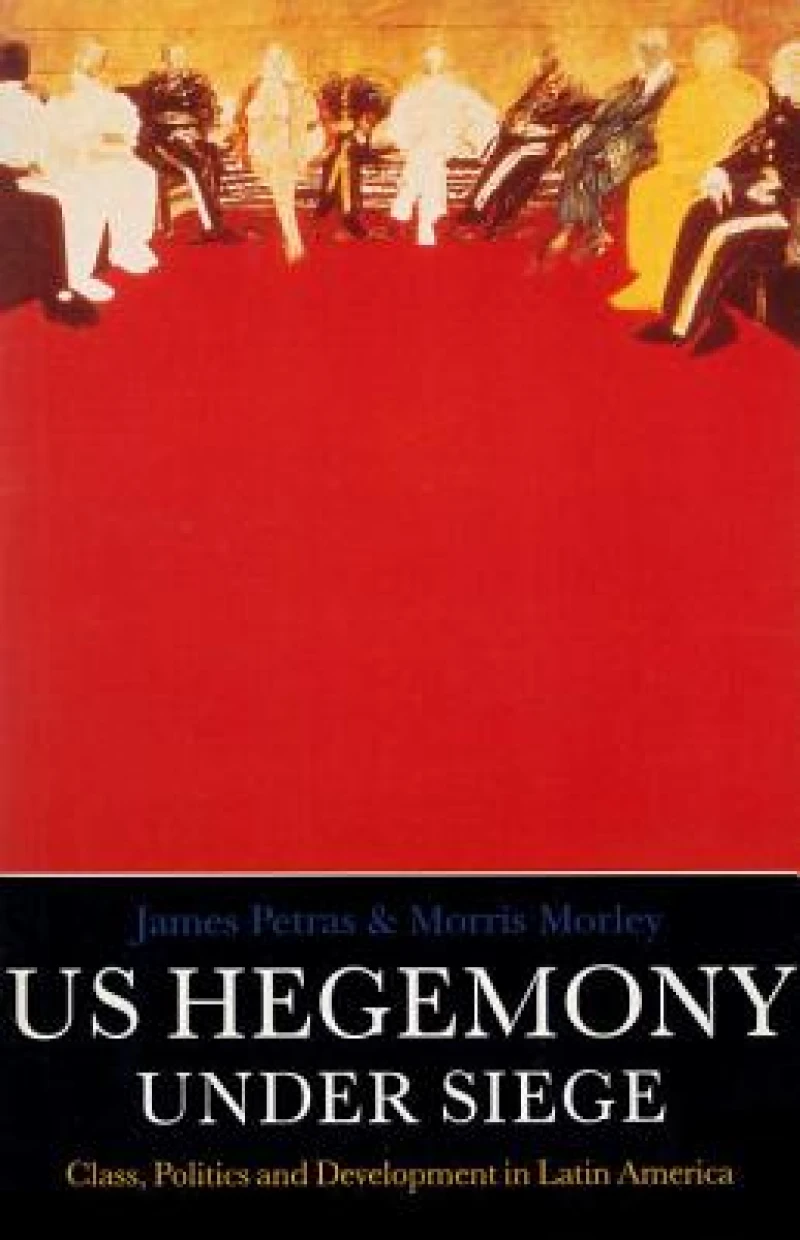
U.S. Hegemony Under Siege : Class, Politics and Development in Latin America
Book Details
Format
Paperback / Softback
ISBN-10
0860919951
ISBN-13
9780860919957
Publisher
Verso Books
Imprint
Verso Books
Country of Manufacture
GB
Country of Publication
GB
Publication Date
Sep 17th, 1990
Print length
266 Pages
Weight
404 grams
Dimensions
23.60 x 15.20 x 1.90 cms
Ksh 3,750.00
Re-Printing
0 in stock
Delivery Location
Delivery fee: Select location
Secure
Quality
Fast
From Menem’s new Thatcherite experiment in Argentina, through Fujimori’s unexpected victory in Peru, to Collor’s near defeat at the hands of the rapidly growing Workers’ Party of Brazil, Latin American politics is once again in turmoil. Whilst military dictators have been dumped from office, their liberal and populist replacements have found television exposure and playboy reputations insufficient to hold together societies still remorselessly squeezed insufficient to hold together societies still remorselessly squeezed by United States foreign policy. But US influence in the subcontinent is not only under siege from the impoverished masses of increasingly unstable states; it is also threatened by intensifying superpower competition as Japan and a unifying Europe mount their challenges for world dominance.
In this wide-ranging and original polemic, Petras and Morley examine the social structures which emerged from neo-liberal economic policy during the 1970s and 1980s. they show how Latin American society is increasingly organized around a continental bourgeoisie maintaining high levels of foreign investment, a national bourgeoisie operating on the margins of legality and committed to both economic deregulation and public-sector activity, and a growing class of low-paid and poorly employed workers subject to the demands of export-oriented capital into international financial circuits is matched by technical and intellectual integration, with a collapse into conformity of formerly critical groupings.
For students and the interested general reader, this balanced and rigorous analysis of state power and social form provides a substantial new framework in which to consider the exigent questions of US-Latin American relations.
In this wide-ranging and original polemic, Petras and Morley examine the social structures which emerged from neo-liberal economic policy during the 1970s and 1980s. they show how Latin American society is increasingly organized around a continental bourgeoisie maintaining high levels of foreign investment, a national bourgeoisie operating on the margins of legality and committed to both economic deregulation and public-sector activity, and a growing class of low-paid and poorly employed workers subject to the demands of export-oriented capital into international financial circuits is matched by technical and intellectual integration, with a collapse into conformity of formerly critical groupings.
For students and the interested general reader, this balanced and rigorous analysis of state power and social form provides a substantial new framework in which to consider the exigent questions of US-Latin American relations.
Get U.S. Hegemony Under Siege by at the best price and quality guaranteed only at Werezi Africa's largest book ecommerce store. The book was published by Verso Books and it has pages.

