
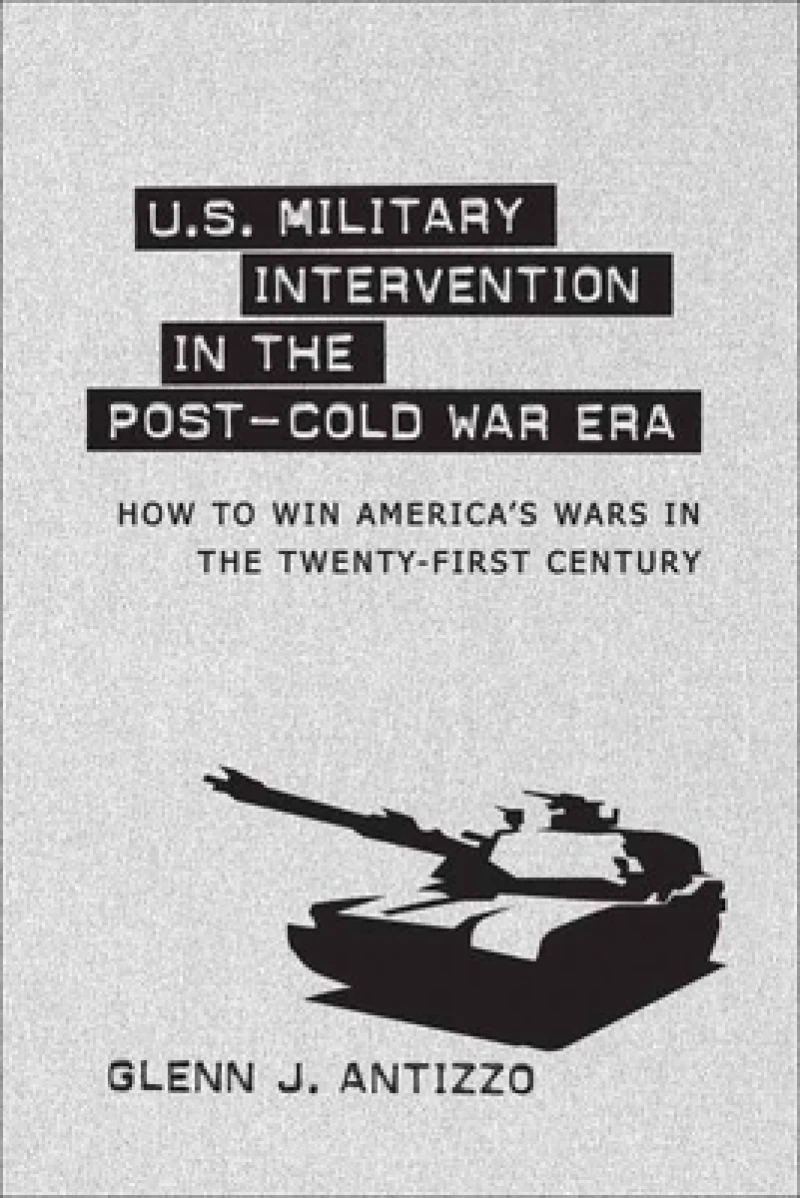
U.S. Military Intervention in the Post-Cold War Era : How to Win America's Wars in the Twenty-first Century
Book Details
Format
Hardback or Cased Book
Book Series
Political Traditions in Foreign Policy Series
ISBN-10
0807136425
ISBN-13
9780807136423
Publisher
Louisiana State University Press
Imprint
Louisiana State University Press
Country of Manufacture
US
Country of Publication
GB
Publication Date
Jun 1st, 2010
Print length
280 Pages
Weight
333 grams
Dimensions
23.10 x 15.40 x 2.20 cms
Product Classification:
Politics & governmentPolitics and government
Ksh 6,500.00
Temporarily out of stock, due soon
0 in stock
Delivery Location
Delivery fee: Select location
Secure
Quality
Fast
Political scientist Glenn Antizzo identifies fifteen factors critical to the success of contemporary US military intervention and evaluates the likely efficacy of direct US military involvement today - when it will work, when it will not, and how to undertake such action in a manner that will bring rapid victory at an acceptable political cost.
During the post-World War II era, American foreign policy prominently featured direct U.S. military intervention in the Third World. Yet the cold war placed restraints on where and how Washington could intervene until the collapse of the former Soviet Union removed many of the barriers to - and ideological justifications for - American intervention. Since the end of the cold war, the United States has completed several military interventions that may be guided by motives very different from those invoked before the collapse of the Berlin Wall. Likewise, such operations, now free from the threat of counterintervention by any other superpower, seem governed by a new set of rules.
In this readily accessible study, political scientist Glenn J. Antizzo identifies fifteen factors critical to the success of contemporary U.S. military intervention and evaluates the likely efficacy of direct U.S. military involvement today - when it will work, when it will not, and how to undertake such action in a manner that will bring rapid victory at an acceptable political cost. He lays out the preconditions that portend success, among them a clear and attainable goal; a mission that is neither for ""peacekeeping"" nor for ""humanitarian aid within a war zone""; a strong probability the American public will support or at least be indifferent to the effort; a willingness to utilize ground forces if necessary; an operation limited in geographic scope; and a theater commander permitted discretion in the course of the operation.
Antizzo then tests his abstract criteria by using real-world case studies of the most recent fully completed U.S. military interventions - in Panama in 1989, Iraq in 1991, Somalia in 1992-94, and Kosovo in 1999 - with Panama, Iraq, and Kosovo representing generally successful interventions and Somalia an unsuccessful one. Finally, he considers how the development of a ""Somalia Syndrome"" affected U.S. foreign policy and how the politics and practice of military intervention have continued to evolve since the terrorist attacks of September 11, 2001, giving specific attention to the current war in Afghanistan and the larger War on Terror.
U.S. Military Intervention in the Post-Cold War Era exemplifies political science at its best: the positing of a hypothetical model followed by a close examination of relevant cases in an effort to provide meaningful insights for future American international policy.
In this readily accessible study, political scientist Glenn J. Antizzo identifies fifteen factors critical to the success of contemporary U.S. military intervention and evaluates the likely efficacy of direct U.S. military involvement today - when it will work, when it will not, and how to undertake such action in a manner that will bring rapid victory at an acceptable political cost. He lays out the preconditions that portend success, among them a clear and attainable goal; a mission that is neither for ""peacekeeping"" nor for ""humanitarian aid within a war zone""; a strong probability the American public will support or at least be indifferent to the effort; a willingness to utilize ground forces if necessary; an operation limited in geographic scope; and a theater commander permitted discretion in the course of the operation.
Antizzo then tests his abstract criteria by using real-world case studies of the most recent fully completed U.S. military interventions - in Panama in 1989, Iraq in 1991, Somalia in 1992-94, and Kosovo in 1999 - with Panama, Iraq, and Kosovo representing generally successful interventions and Somalia an unsuccessful one. Finally, he considers how the development of a ""Somalia Syndrome"" affected U.S. foreign policy and how the politics and practice of military intervention have continued to evolve since the terrorist attacks of September 11, 2001, giving specific attention to the current war in Afghanistan and the larger War on Terror.
U.S. Military Intervention in the Post-Cold War Era exemplifies political science at its best: the positing of a hypothetical model followed by a close examination of relevant cases in an effort to provide meaningful insights for future American international policy.
Get U.S. Military Intervention in the Post-Cold War Era by at the best price and quality guaranteed only at Werezi Africa's largest book ecommerce store. The book was published by Louisiana State University Press and it has pages.

