
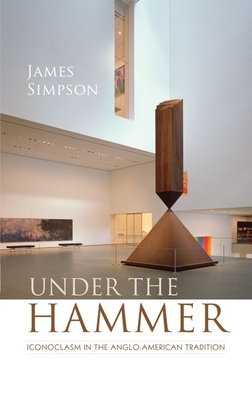
Under the Hammer : Iconoclasm in the Anglo-American Tradition
Book Details
Format
Hardback
Book Series
Clarendon Lectures in English
ISBN-10
0199591652
ISBN-13
9780199591657
Publisher
Oxford University Press
Imprint
Oxford University Press
Country of Manufacture
GB
Country of Publication
GB
Publication Date
Nov 30th, 2010
Print length
238 Pages
Weight
400 grams
Dimensions
22.30 x 14.70 x 1.70 cms
KSh 9,550.00
Currently unavailable
0 in stock
Delivery Location
Delivery fee: Select location
Secure
Quality
Fast
Iconoclasm is not a barbaric act which takes place somewhere else but is instead a central strand of Anglo-American modernity. Our horror at the destruction of art derives in part from the fact that we did, and still do, that. This is most obviously true of England's iconoclastic century between 1538 and 1643, which stands at the core of this book.
When we think of breaking images, we assume that it happens somewhere else. We also tend to think of iconoclasts as barbaric. Iconoclasts are people like the Taliban, who blew up Buddhist statues in 2001. We tend, that is, to look with horror on iconoclasm.This book argues instead that iconoclasm is a central strand of Anglo-American modernity. Our horror at the destruction of art derives in part from the fact that we too did, and still do, that. This is most obviously true of England''s iconoclastic century between 1538 and 1643. That century of legislated early modern image breaking, exceptional in Europe for its jurisdictional extension and duration, stands at the core of this book. That''s when written texts, especially poems, rather than visual images became our living monuments.Surely, though, the story of image breaking stops in the eighteenth century, with its enlightened cultivation of the visual arts and the art market. Not so, argues Under the Hammer: once started, iconoclasm is difficult to stop. It ripples through cultures, into the psyche, and it ripples through history. Museums may have protected images from the iconoclast''s hammer, but also subject images to metaphorical iconoclasm. Aesthetics may have drawn a protective circle around the image, but as it did so, it also neutralised the image. The ripple effect also continues across the Atlantic, into puritan culture, into twentieth-century American Abstract Expressionism, and into the puritan temple of modern art. That, in fact, is where this book starts, with mid-twentieth-century abstract painting: the image has survived, just, but it bears the scars of a 500 year history.
Get Under the Hammer by James Simpson at the best price and quality guaranteed only at Werezi Africa's largest book ecommerce store. The book was published by Oxford University Press and it has 238 pages.
Customers Who Bought This Also Bought

World According to Colour
KSh 2,700.00

The Metropolitan Museum of Art
KSh 13,350.00

The Story of Art
KSh 4,500.00

Artists Who Changed History
KSh 5,900.00

Fashion
KSh 7,800.00

Art
KSh 9,250.00

Story of Art without Men
KSh 2,900.00
Tao Te Ching
KSh 3,050.00
The Invention of Design
KSh 4,500.00

Letters to a Young Painter
KSh 1,950.00

The Jean–Michel Basquiat Reader – Writings, Interviews, and Critical Responses
KSh 14,400.00
Basquiat–isms
KSh 2,350.00
More by James Simpson

Spanish Agriculture
KSh 9,700.00
Creating Wine
KSh 8,650.00
Why Democracy Failed
KSh 5,150.00

Spanish Agriculture
KSh 19,450.00
Permanent Revolution
KSh 5,400.00
Sciences and the Self in Medieval Poetry
KSh 8,050.00

Family Farmers, Land Reforms and Political Action
KSh 19,800.00

Burning to Read – English Fundamentalism and its Reformation Opponents
KSh 4,850.00

Uncommon Sense
KSh 1,050.00
Sciences and the Self in Medieval Poetry
KSh 21,600.00

Goethe and Patriarchy
KSh 12,800.00
Why Democracy Failed
KSh 14,750.00
