

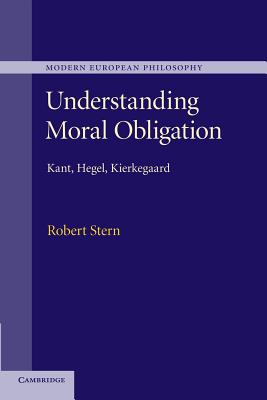
Understanding Moral Obligation : Kant, Hegel, Kierkegaard
by
Robert Stern
Book Details
Format
Hardback
Book Series
Modern European Philosophy
ISBN-10
1107012074
ISBN-13
9781107012073
Publisher
Cambridge University Press
Imprint
Cambridge University Press
Country of Manufacture
GB
Country of Publication
GB
Publication Date
Dec 15th, 2011
Print length
292 Pages
Weight
608 grams
Dimensions
22.90 x 16.00 x 1.90 cms
KSh 17,100.00
Currently unavailable
0 in stock
Delivery Location
Delivery fee: Select location
Secure
Quality
Fast
This book traces the development of theories of moral obligation of three key philosophers, showing how each tries to deal with the tension between obligation and autonomy. Of interest to those concerned with the history of modern ethics and the interaction of historical debate to constructivism and moral realism.
In many histories of modern ethics, Kant is supposed to have ushered in an anti-realist or constructivist turn by holding that unless we ourselves 'author' or lay down moral norms and values for ourselves, our autonomy as agents will be threatened. In this book, Robert Stern challenges the cogency of this 'argument from autonomy', and claims that Kant never subscribed to it. Rather, it is not value realism but the apparent obligatoriness of morality that really poses a challenge to our autonomy: how can this be accounted for without taking away our freedom? The debate the book focuses on therefore concerns whether this obligatoriness should be located in ourselves (Kant), in others (Hegel) or in God (Kierkegaard). Stern traces the historical dialectic that drove the development of these respective theories, and clearly and sympathetically considers their merits and disadvantages; he concludes by arguing that the choice between them remains open.
Get Understanding Moral Obligation by Robert Stern at the best price and quality guaranteed only at Werezi Africa's largest book ecommerce store. The book was published by Cambridge University Press and it has 292 pages.
Customers Who Bought This Also Bought

Thus Spoke Zarathustra
KSh 2,000.00

On War
KSh 1,200.00

Ecce Homo
KSh 1,800.00

On War
KSh 4,500.00

Kierkegaard
KSh 1,800.00

On Art, Religion, and the History of Philosophy
KSh 3,100.00

Critique Of Pure Reason
KSh 2,700.00

Grounding for the Metaphysics of Morals
KSh 2,700.00

Critique of Pure Reason, Abridged
KSh 3,600.00
Discourse on Political Economy and The Social Contract
KSh 1,800.00

Discourse on the Origin of Inequality
KSh 2,150.00

Selected Letters of Friedrich Nietzsche
KSh 4,700.00
More by Robert Stern

Deutsche Handelskorrespondenz
KSh 19,000.00

Balance of Payments
KSh 9,850.00

The Routledge Guidebook to Hegel''s Phenomenology of Spirit
KSh 5,250.00
Understanding Moral Obligation
KSh 6,250.00

Kantian Ethics
KSh 7,200.00
Transcendental Arguments and Scepticism
KSh 13,250.00

Transcendental Arguments and Scepticism
KSh 28,650.00

Hegel, Kant and the Structure of the Object
KSh 11,150.00

The Routledge Guidebook to Hegel''s Phenomenology of Spirit
KSh 30,950.00

Kantian Ethics
KSh 19,600.00
Balance of Payments
KSh 30,950.00
Hegel, Kant and the Structure of the Object
KSh 30,950.00
