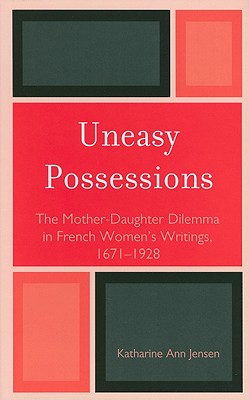
Uneasy Possessions : The Mother-Daughter Dilemma in French WomenOs Writings, 1671-1928
Book Details
Format
Hardback or Cased Book
ISBN-10
1611490383
ISBN-13
9781611490381
Publisher
Bloomsbury Publishing Plc
Imprint
University of Delaware Press
Country of Manufacture
GB
Country of Publication
GB
Publication Date
Jan 27th, 2011
Print length
456 Pages
Weight
810 grams
Dimensions
16.20 x 23.80 x 3.90 cms
Product Classification:
Literary studies: c 1500 to c 1800Literary studies: c 1800 to c 1900 Literary studies: from c 1900 -
Ksh 23,500.00
Manufactured on Demand
0 in stock
Delivery Location
Delivery fee: Select location
Secure
Quality
Fast
In Uneasy Possessions: The Mother-Daughter Dilemma in French Women's Writings, 1671-1928, Katharine Ann Jensen analyzes the work of five major French women writers, discovering a four-century pattern of mother-daughter relationships marked by domination, submission, and conflict. This groundbreaking study explores work of Marie-Madeleine de Lafayette, Marie de Sevigne, Elisabeth Vigee Lebrun, George Sand, and Colette, providing a new reading of women's history and offering a new understanding of female psychology. Jensen argues that conflict between the mothers and daughters depicted in these texts was the result of two contradictory ideologies. In order to pass proper feminine behavior on to their daughters, mothers were encouraged to construe daughters as part of themselves, even as daughters were expected to adopt their mothers' wishes as their own. At the same time, a developing individualism created a conflict between the daughter's desire for autonomy and her mother's wish to be recognized for having raised a perfect daughter-alter ego. Despite vast changes in social organization in France over the four centuries of this study, the mother-daughter ideology remained effectively the same. To keep their daughters virgins, mothers were expected to form their daughters in their own image-as a mirror reflection. Mother-daughter reflectivity extended even into the marriage bed, as daughters were taught to remain faithful and to submit to (male) authority throughout their lives. Thus, the daughter's sexuality was channeled into producing legitimate offspring while the mother's ambition was confined to working on her daughter, rather than focused on creating cultural works that might compete with men's. Mothers were rewarded with the narcissistic satisfaction of viewing their filial creations as a socially sanctioned work of art: daughters thus functioned as possessions.
In Uneasy Possessions: The Mother-Daughter Dilemma in French Women''s Writings, 1671-1928, Katharine Ann Jensen analyzes the work of five major French women writers, discovering a four-century pattern of mother-daughter relationships marked by domination, submission, and conflict. This groundbreaking study explores work of Marie-Madeleine de Lafayette, Marie de Sévigné, Elisabeth Vigée Lebrun, George Sand, and Colette, providing a new reading of women''s history and offering a new understanding of female psychology. Jensen argues that conflict between the mothers and daughters depicted in these texts was the result of two contradictory ideologies. In order to pass proper feminine behavior on to their daughters, mothers were encouraged to construe daughters as part of themselves, even as daughters were expected to adopt their mothers'' wishes as their own. At the same time, a developing individualism created a conflict between the daughter''s desire for autonomy and her mother''s wish to be recognized for having raised a perfect daughter-alter ego. Despite vast changes in social organization in France over the four centuries of this study, the mother-daughter ideology remained effectively the same. To keep their daughters virgins, mothers were expected to form their daughters in their own image-as a mirror reflection. Mother-daughter reflectivity extended even into the marriage bed, as daughters were taught to remain faithful and to submit to (male) authority throughout their lives. Thus, the daughter''s sexuality was channeled into producing legitimate offspring while the mother''s ambition was confined to working on her daughter, rather than focused on creating cultural works that might compete with men''s. Mothers were rewarded with the narcissistic satisfaction of viewing their filial creations as a socially sanctioned work of art: daughters thus functioned as possessions.
Get Uneasy Possessions by at the best price and quality guaranteed only at Werezi Africa's largest book ecommerce store. The book was published by Bloomsbury Publishing Plc and it has pages.