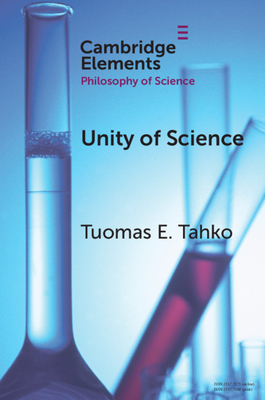
Unity of Science
Book Details
Format
Paperback / softback
Book Series
Elements in the Philosophy of Science
ISBN-10
1108713386
ISBN-13
9781108713382
Publisher
Cambridge University Press
Imprint
Cambridge University Press
Country of Manufacture
GB
Country of Publication
GB
Publication Date
Feb 11th, 2021
Print length
80 Pages
Weight
136 grams
Dimensions
22.80 x 15.20 x 0.90 cms
Product Classification:
Philosophy of scienceHistory of science
KSh 3,250.00
Currently unavailable
0 in stock
Delivery Location
Delivery fee: Select location
Secure
Quality
Fast
What kind of reductionism does multiple realisability challenge? What does it take to reduce one phenomenon to another? How do we determine which kinds are natural? What is the ontological basis of unity? In this Element, Tuomas Tahko examines these questions from a contemporary perspective, after a historical overview.
Unity of science was once a very popular idea among both philosophers and scientists. But it has fallen out of fashion, largely because of its association with reductionism and the challenge from multiple realisation. Pluralism and the disunity of science are the new norm, and higher-level natural kinds and special science laws are considered to have an important role in scientific practice. What kind of reductionism does multiple realisability challenge? What does it take to reduce one phenomenon to another? How do we determine which kinds are natural? What is the ontological basis of unity? In this Element, Tuomas Tahko examines these questions from a contemporary perspective, after a historical overview. The upshot is that there is still value in the idea of a unity of science. We can combine a modest sense of unity with pluralism and give an ontological analysis of unity in terms of natural kind monism. This title is available as Open Access on Cambridge Core.
Get Unity of Science by Tuomas E. Tahko at the best price and quality guaranteed only at Werezi Africa's largest book ecommerce store. The book was published by Cambridge University Press and it has 80 pages.
Customers Who Bought This Also Bought
The Poetics of Space
KSh 2,700.00

Origin of Species
KSh 1,850.00

Arrogant Ape
KSh 3,050.00

Classics Origin of Species
KSh 1,100.00
The Structure of Scientific Revolutions – 50th Anniversary Edition
KSh 2,850.00
Xrepublic
KSh 850.00
Xrepublic
KSh 1,450.00

Theory of Scientific Method
KSh 4,300.00

Vocation Lectures
KSh 2,900.00

Kinship: Vol. 5 Practice
KSh 3,250.00

Thinking Beyond Materialism
KSh 3,400.00

Thinking Beyond Materialism
KSh 15,550.00