
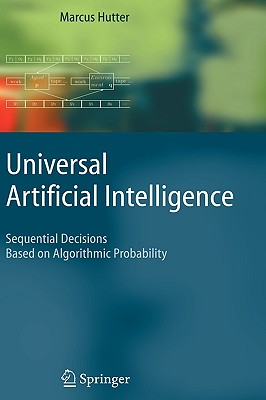
Universal Artificial Intelligence : Sequential Decisions Based on Algorithmic Probability
2005 ed.
Book Details
Format
Hardback
ISBN-10
3540221395
ISBN-13
9783540221395
Edition
2005 ed.
Publisher
Springer-Verlag Berlin and Heidelberg GmbH & Co. KG
Imprint
Springer-Verlag Berlin and Heidelberg GmbH & Co. K
Country of Manufacture
DE
Country of Publication
GB
Publication Date
Oct 12th, 2004
Print length
278 Pages
Weight
588 grams
Dimensions
24.10 x 15.70 x 2.10 cms
Product Classification:
Artificial intelligenceArtificial intelligence (AI)
KSh 14,400.00
Currently unavailable
0 in stock
Delivery Location
Delivery fee: Select location
Secure
Quality
Fast
A solution would have enormous implications on our society, and there are reasons to believe that the AI problem can be solved in my expected lifetime. The science of artificial intelligence (AI) may be defined as the construction of intelligent systems and their analysis. The goal of AI systems should be to be useful to humans.
Personal motivation. The dream of creating artificial devices that reach or outperform human inteUigence is an old one. It is also one of the dreams of my youth, which have never left me. What makes this challenge so interesting? A solution would have enormous implications on our society, and there are reasons to believe that the AI problem can be solved in my expected lifetime. So, it's worth sticking to it for a lifetime, even if it takes 30 years or so to reap the benefits. The AI problem. The science of artificial intelligence (AI) may be defined as the construction of intelligent systems and their analysis. A natural definition of a system is anything that has an input and an output stream. Intelligence is more complicated. It can have many faces like creativity, solving prob lems, pattern recognition, classification, learning, induction, deduction, build ing analogies, optimization, surviving in an environment, language processing, and knowledge. A formal definition incorporating every aspect of intelligence, however, seems difficult. Most, if not all known facets of intelligence can be formulated as goal driven or, more precisely, as maximizing some utility func tion. It is, therefore, sufficient to study goal-driven AI; e. g. the (biological) goal of animals and humans is to survive and spread. The goal of AI systems should be to be useful to humans.
Get Universal Artificial Intelligence by Marcus Hutter at the best price and quality guaranteed only at Werezi Africa's largest book ecommerce store. The book was published by Springer-Verlag Berlin and Heidelberg GmbH & Co. KG and it has 278 pages.
Customers Who Bought This Also Bought

Magnifica Humanitas
KSh 1,500.00

Nexus
KSh 2,350.00
The Thinking Machine
KSh 2,350.00
The Reverse Centaur's Guide to Life After AI
KSh 3,050.00

The MANIAC
KSh 2,000.00
Thinking With Machines: The Brave New World of AI
KSh 4,300.00
Prediction Machines
KSh 3,950.00

Confident AI
KSh 3,050.00
Responsible AI
KSh 6,400.00
Empire of AI
KSh 4,500.00

The MANIAC
KSh 2,700.00

Data Management, Analytics and Innovation
KSh 32,400.00


