
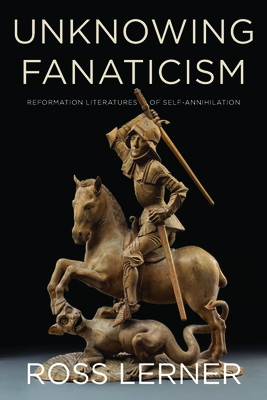
Book Details
Format
Paperback / softback
ISBN-10
0823283860
ISBN-13
9780823283866
Edition
New
Publisher
Fordham University Press
Imprint
Fordham University Press
Country of Manufacture
GB
Country of Publication
GB
Publication Date
Apr 2nd, 2019
Print length
277 Pages
Weight
372 grams
Dimensions
15.20 x 23.00 x 1.80 cms
KSh 4,500.00
Currently unavailable
0 in stock
Delivery Location
Delivery fee: Select location
Secure
Quality
Fast
We may think we know what defines religious fanaticism: violent action undertaken with dogmatic certainty. But the term fanatic, from the European Reformation to today, has never been a stable one. Then and now it has been reductively defined to justify state violence and to delegitimize alternative sources of authority. Unknowing Fanaticism rejects the simplified binary of fanatical religion and rational politics, turning to Renaissance literature to demonstrate that fanaticism was integral to how both modern politics and poetics developed, from the German Peasants' Revolt to the English Civil War. The book traces two entangled approaches to fanaticism in this long Reformation moment: the targeting of it as an extreme political threat and the engagement with it as a deep epistemological and poetic problem. In the first, thinkers of modernity from Martin Luther to Thomas Hobbes and John Locke positioned themselves against fanaticism to pathologize rebellion and abet theological and political control. In the second, which arose alongside and often in response to the first, the poets of fanaticism investigated the link between fanatical self-annihilation—the process by which one could become a vessel for divine violence—and the practices of writing poetry. Edmund Spenser, John Donne, and John Milton recognized in the fanatic's claim to be a passive instrument of God their own incapacity to know and depict the origins of fanaticism. Yet this crisis of unknowing was a productive one. It led these writers to experiment with poetic techniques that would allow them to address fanaticism's tendency to unsettle the boundaries between human and divine agency and between individual and collective bodies. These poets demand a new critical method, which this book attempts to model: a historically-minded and politicized formalism that can attend to the complexity of the poetic encounter with fanaticism.
Get Unknowing Fanaticism by Ross Lerner at the best price and quality guaranteed only at Werezi Africa's largest book ecommerce store. The book was published by Fordham University Press and it has 277 pages.
Customers Who Bought This Also Bought

Arabian Nights'' Entertainments
KSh 2,950.00
Robinson Crusoe
KSh 1,450.00
Metaphysical Poetry
KSh 2,350.00
A Portrait of the Artist as a Young Man
KSh 1,250.00

Shakespeare Book
KSh 4,250.00
Don Quixote de la Mancha
KSh 2,150.00

Lorna Doone
KSh 2,000.00

Tom Jones
KSh 5,400.00

Tom Jones
KSh 2,250.00

Micromégas and Other Short Fictions
KSh 2,350.00
Murder Among Friends
KSh 22,750.00

Hamlet: Poem Unlimited
KSh 1,800.00
