
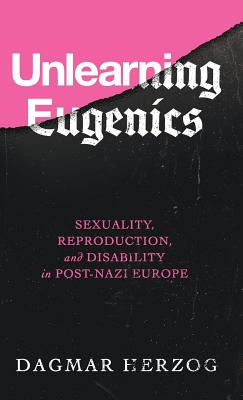
Unlearning Eugenics : Sexuality, Reproduction, and Disability in Post-Nazi Europe
Book Details
Format
Hardback
ISBN-10
0299319202
ISBN-13
9780299319205
Publisher
University of Wisconsin Press
Imprint
University of Wisconsin Press
Country of Manufacture
US
Country of Publication
GB
Publication Date
Oct 30th, 2018
Print length
176 Pages
Weight
370 grams
Dimensions
14.70 x 22.30 x 1.80 cms
KSh 5,850.00
Publisher Out of Stock
0 in stock
Delivery Location
Delivery fee: Select location
Secure
Quality
Fast
Bringing together the latest findings in Holocaust studies, the history of religion, and the history of sexuality in postwar - and now also postcommunist - Europe, Unlearning Eugenics shows how central the controversies over sexuality, reproduction, and disability have been to broader processes of secularization and religious renewal.
Since the defeat of the Nazi Third Reich and the end of its horrific eugenics policies, battles over the politics of life, sex, and death have continued and evolved. Dagmar Herzog documents how reproductive rights and disability rights, both latecomers to the postwar human rights canon, came to be seen as competing—with unexpected consequences.
Bringing together the latest findings in Holocaust studies, the history of religion, and the history of sexuality in postwar—and now also postcommunist—Europe, Unlearning Eugenics shows how central the controversies over sexuality, reproduction, and disability have been to broader processes of secularization and religious renewal. Herzog also restores to the historical record a revelatory array of activists: from Catholic and Protestant theologians who defended abortion rights in the 1960s–70s to historians in the 1980s–90s who uncovered the long-suppressed connections between the mass murder of the disabled and the Holocaust of European Jewry; from feminists involved in the militant ""cripple movement"" of the 1980s to lawyers working for right-wing NGOs in the 2000s; and from a handful of pioneers in the 1940s–60s committed to living in intentional community with individuals with cognitive disability to present-day disability self-advocates.
Bringing together the latest findings in Holocaust studies, the history of religion, and the history of sexuality in postwar—and now also postcommunist—Europe, Unlearning Eugenics shows how central the controversies over sexuality, reproduction, and disability have been to broader processes of secularization and religious renewal. Herzog also restores to the historical record a revelatory array of activists: from Catholic and Protestant theologians who defended abortion rights in the 1960s–70s to historians in the 1980s–90s who uncovered the long-suppressed connections between the mass murder of the disabled and the Holocaust of European Jewry; from feminists involved in the militant ""cripple movement"" of the 1980s to lawyers working for right-wing NGOs in the 2000s; and from a handful of pioneers in the 1940s–60s committed to living in intentional community with individuals with cognitive disability to present-day disability self-advocates.
Get Unlearning Eugenics by Dagmar Herzog at the best price and quality guaranteed only at Werezi Africa's largest book ecommerce store. The book was published by University of Wisconsin Press and it has 176 pages.
Customers Who Bought This Also Bought
Age of Revolutions
KSh 2,350.00

Eichmann in Jerusalem
KSh 2,350.00

Trouble With Being Born
KSh 2,000.00

Hiroshima
KSh 2,000.00
Freedom
KSh 6,300.00

Holocaust
KSh 2,700.00
The History of the Peloponnesian War
KSh 2,700.00
Annals
KSh 2,350.00
Greek Lives
KSh 2,150.00
Sleepwalkers
KSh 3,400.00

Napoleon The Great
KSh 3,600.00

Diary of a Young Girl
KSh 1,800.00
More by Dagmar Herzog

The Question of Unworthy Life
KSh 4,500.00

The New Fascist Body
KSh 2,900.00
Intimacy and Exclusion – Religious Politics in Pre–Revolutionary Baden
KSh 18,000.00

The Question of Unworthy Life
KSh 5,400.00
Sexuality in Europe
KSh 14,750.00
Cold War Freud
KSh 5,900.00
Cold War Freud
KSh 4,450.00

Intimacy and Exclusion
KSh 7,550.00
Sexuality in Europe
KSh 4,700.00
Intimacy and Exclusion
KSh 30,950.00

Intimacy and Exclusion
KSh 9,350.00
Sex after Fascism – Memory and Morality in Twentieth–Century Germany
KSh 7,200.00
