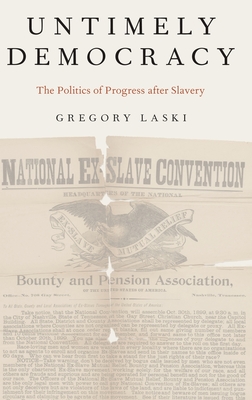
Untimely Democracy : The Politics of Progress After Slavery
Book Details
Format
Paperback / softback
ISBN-10
019762412X
ISBN-13
9780197624128
Publisher
Oxford University Press Inc
Imprint
Oxford University Press Inc
Country of Manufacture
GB
Country of Publication
GB
Publication Date
Apr 29th, 2022
Print length
286 Pages
Weight
422 grams
Dimensions
15.50 x 23.90 x 1.70 cms
KSh 7,150.00
Currently unavailable
0 in stock
Delivery Location
Delivery fee: Select location
Secure
Quality
Fast
Untimely Democracy offers an exploration of how one of the bleakest periods in American racial history provided fertile terrain for a radical reconstruction of America's most fundamental assumptions about democracy.
From the abolition era to the Civil Rights movement to the age of Obama, the promise of perfectibility and improvement resonates in the story of American democracy. But what exactly does racial "progress" mean, and how do we recognize and achieve it? Untimely Democracy: The Politics of Progress After Slavery uncovers a surprising answer to this question in the writings of American authors and activists, both black and white. Conventional narratives of democracy stretching from Thomas Jefferson''s America to our own posit a purposeful break between past and present as the key to the viability of this political form--the only way to ensure its continual development. But for Pauline E. Hopkins, Frederick Douglass, Stephen Crane, W. E. B. Du Bois, Charles W. Chesnutt, Sutton E. Griggs, Callie House, and the other figures examined in this book, the campaign to secure liberty and equality for all citizens proceeds most potently when it refuses the precepts of progressive time. Placing these authors'' post-Civil War writings into dialogue with debates about racial optimism and pessimism, tracts on progress, and accounts of ex-slave pension activism, and extending their insights into our contemporary period, Laski recovers late-nineteenth-century literature as a vibrant site for doing political theory. Untimely Democracy ultimately shows how one of the bleakest periods in American racial history provided fertile terrain for a radical reconstruction of our most fundamental assumptions about this political system. Offering resources for moments when the march of progress seems to stutter and even stop, this book invites us to reconsider just what democracy can make possible.
Get Untimely Democracy by Gregory Laski at the best price and quality guaranteed only at Werezi Africa's largest book ecommerce store. The book was published by Oxford University Press Inc and it has 286 pages.
Customers Who Bought This Also Bought

The Picture of Dorian Gray
KSh 1,250.00

Pride and Prejudice
KSh 1,150.00

Moby-Dick
KSh 1,750.00
Emma
KSh 1,350.00
The Karamazov Brothers
KSh 2,100.00

Persuasion
KSh 1,100.00

Bleak House
KSh 2,150.00

What Matters in Jane Austen?
KSh 2,700.00

A Tale of Two Cities
KSh 1,200.00
Little Women
KSh 1,550.00

David Copperfield
KSh 2,100.00

Mansfield Park
KSh 1,250.00