
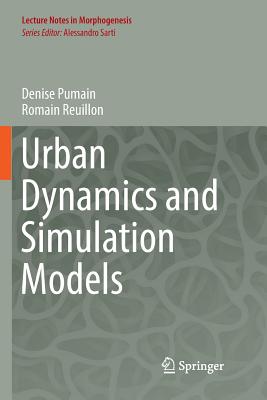
Urban Dynamics and Simulation Models
Softcover reprint of the original 1st ed. 2017
Book Details
Format
Paperback / softback
Book Series
Lecture Notes in Morphogenesis
ISBN-10
3319835289
ISBN-13
9783319835280
Edition
Softcover reprint of the original 1st ed. 2017
Publisher
Springer International Publishing AG
Imprint
Springer International Publishing AG
Country of Manufacture
GB
Country of Publication
GB
Publication Date
Jul 13th, 2018
Print length
123 Pages
KSh 19,800.00
Currently unavailable
0 in stock
Delivery Location
Delivery fee: Select location
Secure
Quality
Fast
This monograph presents urban simulation methods that help in better understanding urban dynamics. The high frequency and intensity of interactions between cities explain that urban systems all over the world exhibit large similarities in their hierarchical and functional structure and rather regular dynamics.
This monograph presents urban simulation methods that help in better understanding urban dynamics. Over historical times, cities have progressively absorbed a larger part of human population and will concentrate three quarters of humankind before the end of the century. This “urban transition” that has totally transformed the way we inhabit the planet is globally understood in its socio-economic rationales but is less frequently questioned as a spatio-temporal process. However, the cities, because they are intrinsically linked in a game of competition for resources and development, self organize in “systems of cities” where their future becomes more and more interdependent. The high frequency and intensity of interactions between cities explain that urban systems all over the world exhibit large similarities in their hierarchical and functional structure and rather regular dynamics. They are complex systems whose emergence, structure and further evolution are widely governed by the multiple kinds of interaction that link the various actors and institutions investing in cities their efforts, capital, knowledge and intelligence. Simulation models that reconstruct this dynamics may help in better understanding it and exploring future plausible evolutions of urban systems. This would provide better insight about how societies can manage the ecological transition at local, regional and global scales. The author has developed a series of instruments that greatly improve the techniques of validation for such models of social sciences that can be submitted to many applications in a variety of geographical situations. Examples are given for several BRICS countries, Europe and United States. The target audience primarily comprises research experts in the field of urban dynamics, but the book may also be beneficial for graduate students.
Get Urban Dynamics and Simulation Models by Denise Pumain, Romain Reuillon at the best price and quality guaranteed only at Werezi Africa's largest book ecommerce store. The book was published by Springer International Publishing AG and it has 123 pages.
Customers Who Bought This Also Bought

Thinking in Systems
KSh 3,050.00

For Everyone Bible Study Guide: Luke
KSh 1,250.00

The Laws of Thought
KSh 2,000.00

Laws of Thought
KSh 3,050.00

Laws of Thought
KSh 4,500.00

Frankenstein and STEAM – Essays for Charles E. Robinson
KSh 22,300.00

Algorithms in Advanced Artificial Intelligence
KSh 30,950.00

Algorithms in Advanced Artificial Intelligence
KSh 9,350.00

Linear Systems Theory
KSh 37,800.00

Fractals and Chaos
KSh 28,450.00
Theories and Models of Urbanization
KSh 26,800.00
Machine Intelligence and Data Analytics for Sustainable Future Smart Cities
KSh 27,000.00

