
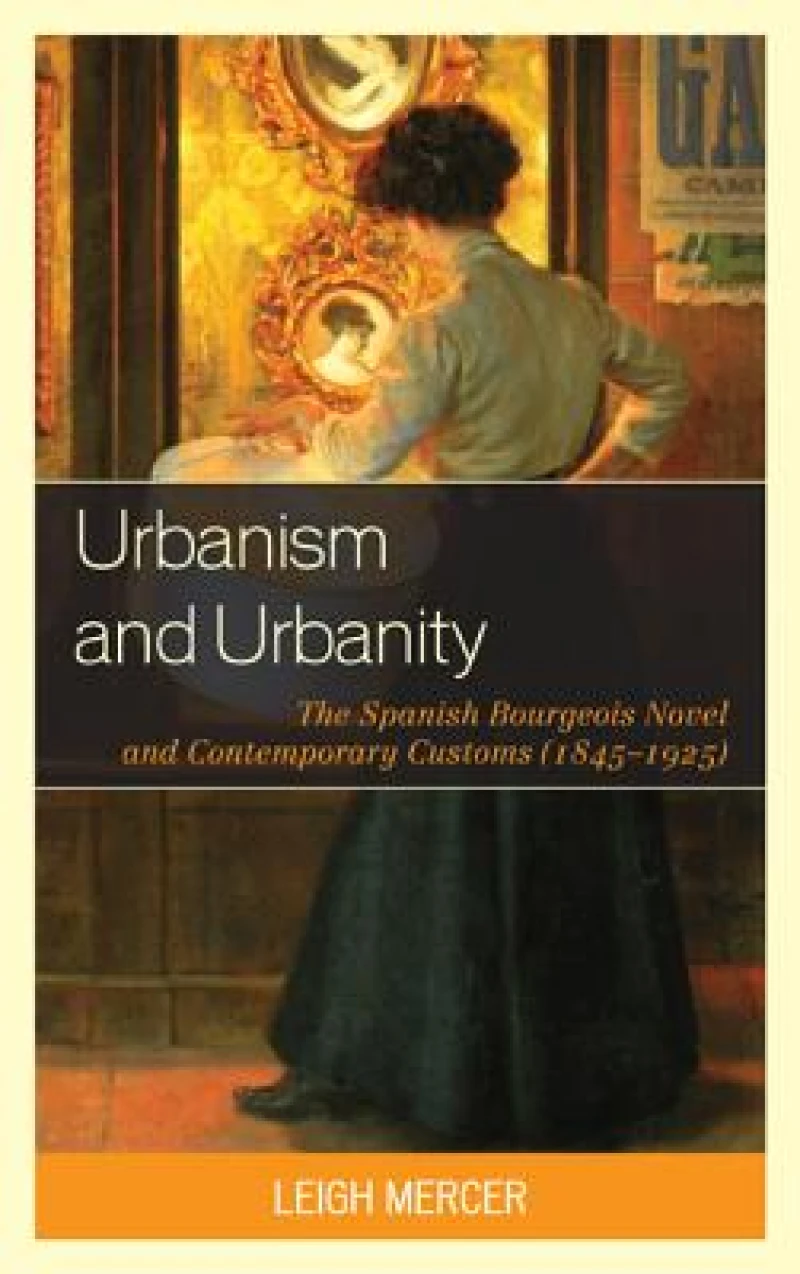
Urbanism and Urbanity : The Spanish Bourgeois Novel and Contemporary Customs (1845–1925)
by
Leigh Mercer
Book Details
Format
Hardback or Cased Book
ISBN-10
1611483883
ISBN-13
9781611483888
Publisher
Bucknell University Press
Imprint
Bucknell University Press
Country of Manufacture
GB
Country of Publication
GB
Publication Date
Nov 21st, 2012
Print length
214 Pages
Weight
463 grams
Dimensions
23.70 x 15.70 x 2.20 cms
Product Classification:
Literary studies: c 1800 to c 1900 Literary studies: fiction, novelists & prose writers
Ksh 17,450.00
Manufactured on Demand
0 in stock
Delivery Location
Delivery fee: Select location
Secure
Quality
Fast
Through the study of more than twenty novels produced in Spain from the 1840s to the 1920s, this book explores the literary means by which the social options available to modern Spanish bourgeois citizens were discursively constructed, occasionally before and often concomitantly to their production in reality. As a result, this study is concerned with the interplay of realism and reality in modern Spain. From the earliest folletines of the 1840s to the Modernist novels of the 1920s, the majority of novels written in this eighty-year period are what one might term novelas de costumbres contemporáneas, or novels of contemporary customs, and therefore primarily concerned with faithfully copying and moreover influencing real social norms in the public sphere. In these pages, I argue that the spatial and behavioral discourses in the novels of contemporary customs offer a telling history of the evolving formulation of the Spanish bourgeoisie. The linking of novels and urbanism is hardly arbitrary in the context of nineteenth-century Spain. Urbanism, particularly in the nineteenth century, was as much a verbal construction as the novel, as proven by the lengthy treatises of such prominent Spanish bureaucrats, engineers, architects, and urban planners as Ramón de Mesonero Romanos, Ildefons Cerdà and Carlos María de Castro. For Spanish intellectuals of this era, city planning and the novel functioned as parallel, enmeshed discourses in which to work out what it meant to be middle class and the roles this class ought to play in contemporary society. In this way, they can be considered associated fields of discourse, in the sense described by Michel Foucault in The Archaeology of Knowledge. Foucault''s treatise was a call for scholars to reexamine historical fields and question the historical grouping of knowledge(s) into certain discursive unities, and consider whether these might be broken up and new ones conceived. In this vein, this book undertakes a broader and more integrative view of the Spanish nineteenth century, calling into question the boundaries of fields such as etiquette and urban planning, or literature and touristic discourse.
Through the study of more than twenty novels produced in Spain from the 1840s to the 1920s, this book explores the literary means by which the social options available to modern Spanish bourgeois citizens were discursively constructed, occasionally before and often concomitantly to their production in reality. As a result, this study is concerned with the interplay of realism and reality in modern Spain. From the earliest folletines of the 1840s to the Modernist novels of the 1920s, the majority of novels written in this eighty-year period are what one might term novelas de costumbres contemporáneas, or novels of contemporary customs, and therefore primarily concerned with faithfully copying and moreover influencing real social norms in the public sphere. In these pages, I argue that the spatial and behavioral discourses in the novels of contemporary customs offer a telling history of the evolving formulation of the Spanish bourgeoisie. The linking of novels and urbanism is hardly arbitrary in the context of nineteenth-century Spain. Urbanism, particularly in the nineteenth century, was as much a verbal construction as the novel, as proven by the lengthy treatises of such prominent Spanish bureaucrats, engineers, architects, and urban planners as Ramón de Mesonero Romanos, Ildefons Cerdà and Carlos María de Castro. For Spanish intellectuals of this era, city planning and the novel functioned as parallel, enmeshed discourses in which to work out what it meant to be middle class and the roles this class ought to play in contemporary society. In this way, they can be considered associated fields of discourse, in the sense described by Michel Foucault in The Archaeology of Knowledge. Foucault's treatise was a call for scholars to reexamine historical fields and question the historical grouping of knowledge(s) into certain discursive unities, and consider whether these might be broken up and new ones conceived. In this vein, this book undertakes a broader and more integrative view of the Spanish nineteenth century, calling into question the boundaries of fields such as etiquette and urban planning, or literature and touristic discourse.
Get Urbanism and Urbanity by at the best price and quality guaranteed only at Werezi Africa's largest book ecommerce store. The book was published by Bucknell University Press and it has pages.

