

Versatile Video Coding
Book Details
Format
Paperback / softback
ISBN-10
8770043671
ISBN-13
9788770043670
Publisher
River Publishers
Imprint
River Publishers
Country of Manufacture
GB
Country of Publication
GB
Publication Date
Oct 21st, 2024
Print length
458 Pages
Weight
760 grams
KSh 7,750.00
Currently unavailable
0 in stock
Delivery Location
Delivery fee: Select location
Secure
Quality
Fast
The book discusses the advances in lossless coding and covers the topic of screen content coding. Technical topics discussed include: Beyond the High Efficiency Video CodingHigh Efficiency Video Coding encoderScreen contentLossless and visually lossless coding algorithms,Fast coding algorithmsVisual quality assessment.
Video is the main driver of bandwidth use, accounting for over 80 per cent of consumer Internet traffic. Video compression is a critical component of many of the available multimedia applications, it is necessary for storage or transmission of digital video over today''s band-limited networks. The majority of this video is coded using international standards developed in collaboration with ITU-T Study Group and MPEG. The MPEG family of video coding standards begun on the early 1990s with MPEG-1, developed for video and audio storage on CD-ROMs, with support for progressive video. MPEG-2 was standardized in 1995 for applications of video on DVD, standard and high definition television, with support for interlaced and progressive video. MPEG-4 part 2, also known as MPEG-2 video, was standardized in 1999 for applications of low- bit rate multimedia on mobile platforms and the Internet, with the support of object-based or content based coding by modeling the scene as background and foreground. Since MPEG-1, the main video coding standards were based on the so-called macroblocks. However, research groups continued the work beyond the traditional video coding architectures and found that macroblocks could limit the performance of the compression when using high-resolution video. Therefore, in 2013 the high efficiency video coding (HEVC) also known and H.265, was released, with a structure similar to H.264/AVC but using coding units with more flexible partitions than the traditional macroblocks. HEVC has greater flexibility in prediction modes and transform block sizes, also it has a more sophisticated interpolation and de blocking filters. In 2006 the VC-1 was released. VC-1 is a video codec implemented by Microsoft and the Microsoft Windows Media Video (VMW) 9 and standardized by the Society of Motion Picture and Television Engineers (SMPTE). In 2017 the Joint Video Experts Team (JVET) released a call for proposals for a new video coding standard initially called Beyond the HEVC, Future Video Coding (FVC) or known as Versatile Video Coding (VVC). VVC is being built on top of HEVC for application on Standard Dynamic Range (SDR), High Dynamic Range (HDR) and 360° Video. The VVC is planned to be finalized by 2020. This book presents the new VVC, and updates on the HEVC. The book discusses the advances in lossless coding and covers the topic of screen content coding. Technical topics discussed include: Beyond the High Efficiency Video CodingHigh Efficiency Video Coding encoderScreen contentLossless and visually lossless coding algorithmsFast coding algorithmsVisual quality assessmentOther screen content coding algorithmsOverview of JPEG Series
Get Versatile Video Coding by Humberto Ochoa Dominguez, K.R. Rao at the best price and quality guaranteed only at Werezi Africa's largest book ecommerce store. The book was published by River Publishers and it has 458 pages.
Customers Who Bought This Also Bought

Methods in Molecular Biophysics
KSh 12,650.00
MRI in Practice
KSh 8,350.00
Musculoskeletal Imaging Handbook
KSh 8,650.00

fMRI Techniques and Protocols
KSh 36,000.00
Prostate Cancer Imaging
KSh 42,300.00

The Neuroimaging of Brain Diseases
KSh 18,000.00

Acute Abdomen During Pregnancy
KSh 19,800.00

Histopathology of Bone and Joint Infections
KSh 21,600.00
Advances in Cardiac Computed Tomography, An Issue of Cardiology Clinics
KSh 11,350.00

Workbook for Radiation Safety and Radiobiology in Medical Imaging
KSh 8,450.00

Functional Neuroradiology
KSh 39,600.00

Polymer Composites and Nanocomposites for X-Rays Shielding
KSh 8,100.00
More by Humberto Ochoa Dominguez, K.R. Rao
Wireless Multimedia Communications
KSh 33,850.00
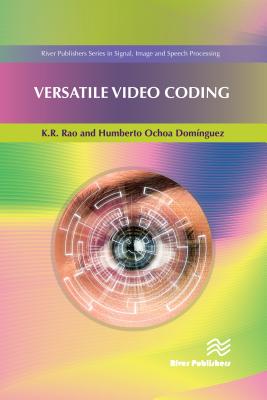
Versatile Video Coding
KSh 16,700.00
Wireless Multimedia Communication Systems
KSh 52,200.00
High Efficiency Video Coding and Other Emerging Standards
KSh 14,750.00

High Efficiency Video Coding and Other Emerging Standards
KSh 6,750.00

Jpeg Series
KSh 8,000.00
Wireless Multimedia Communication Systems
KSh 19,800.00
