
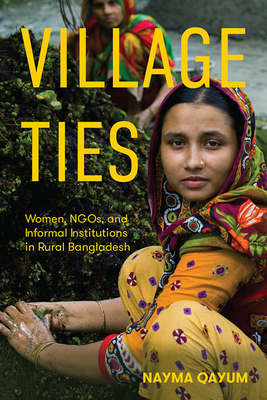
Village Ties : Women, NGOs, and Informal Institutions in Rural Bangladesh
by
Nayma Qayum
Book Details
Format
Paperback / softback
ISBN-10
1978816448
ISBN-13
9781978816442
Publisher
Rutgers University Press
Imprint
Rutgers University Press
Country of Manufacture
US
Country of Publication
GB
Publication Date
Nov 12th, 2021
Print length
230 Pages
Weight
332 grams
Dimensions
15.40 x 22.80 x 2.20 cms
Product Classification:
AsiaSociety and culture: generalRural communities / rural lifeGender studies: women and girlsSociety & culture: generalRural communitiesGender studies: womenSocial & cultural anthropology, ethnographySocial and cultural anthropologyPolitics & governmentPolitics and governmentCentral / national / federal government policiesCentral government policiesNon-governmental organizations (NGOs)
KSh 5,050.00
Temporarily out of stock, due soon
0 in stock
Delivery Location
Delivery fee: Select location
Secure
Quality
Fast
Takes the reader to Bangladesh, a country that has risen from the ashes of war, natural disaster, and decades of resource drain to become a development miracle. The book argues that grassroots women's mobilization programs can empower women to challenge informal institutions when such programs are anti-oppression and embedded in their communities.
Across the global South, poor women''s lives are embedded in their social relationships and governed not just by formal institutions – rules that exist on paper – but by informal norms and practices. Village Ties takes the reader to Bangladesh, a country that has risen from the ashes of war, natural disaster, and decades of resource drain to become a development miracle. The book argues that grassroots women''s mobilization programs can empower women to challenge informal institutions when such programs are anti-oppression, deliberative, and embedded in their communities. Qayum dives into the work of Polli Shomaj (PS), a program of the development organization BRAC to show how the women of PS negotiate with state and society to alter the rules of the game, changing how poor people access resources including safety nets, the law, and governing spaces. These women create a complex and rapidly transforming world where multiple overlapping institutions exist – formal and informal, old and new, desirable and undesirable. In actively challenging power structures around them, these women defy stereotypes of poor Muslim women as backward, subservient, oppressed, and in need of saving.
Get Village Ties by Nayma Qayum at the best price and quality guaranteed only at Werezi Africa's largest book ecommerce store. The book was published by Rutgers University Press and it has 230 pages.
Customers Who Bought This Also Bought

Africa Dances
KSh 2,700.00

Its Our Turn to Eat
KSh 2,350.00
Stranger Faces
KSh 2,500.00
The 48 Laws Of Power
KSh 3,600.00

Wild Seed
KSh 2,350.00

Patternmaster
KSh 2,350.00

Clay's Ark
KSh 2,350.00

Mind of My Mind
KSh 2,350.00

Clay''s Ark
KSh 2,000.00

Mind of My Mind
KSh 2,000.00

Biased
KSh 2,150.00

Identity
KSh 2,150.00
