
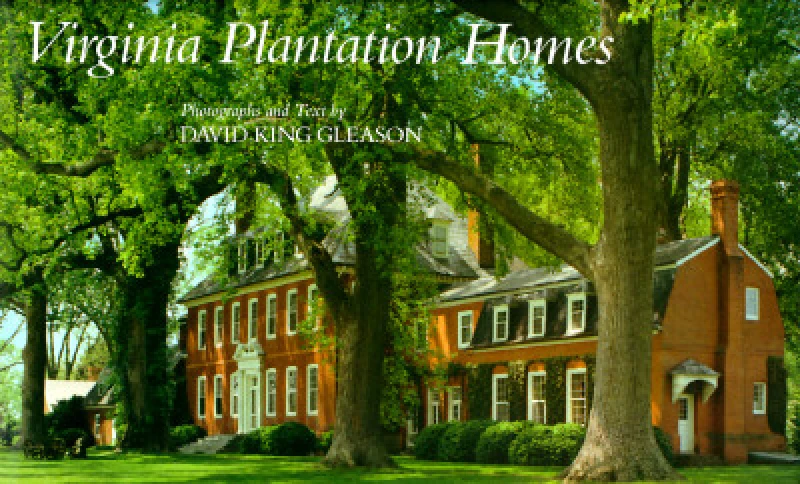
Virginia Plantation Homes
Book Details
Format
Hardback or Cased Book
ISBN-10
0807115703
ISBN-13
9780807115701
Publisher
Louisiana State University Press
Imprint
Louisiana State University Press
Country of Manufacture
US
Country of Publication
GB
Publication Date
Sep 1st, 1989
Print length
160 Pages
Weight
1,633 grams
Dimensions
36.30 x 26.10 x 2.20 cms
Product Classification:
Architecture: residential and domestic buildingsResidential buildings, domestic buildings
Ksh 9,050.00
Temporarily out of stock, due soon
0 in stock
Delivery Location
Delivery fee: Select location
Secure
Quality
Fast
David King Gleason provides a grand tour of Virginia's distinctive plantation homes. As the architectural historian Calder Loth states in his prefatory note, ""Gleason's elegant photographs provide a seductive image of life in 'Old Virginia.' He presents one inviting house after another, complete with handsome interiors, and spacious grounds dotted with boxwoods and venerable trees.""
Unlike those in the Deep South, most of Virginia's plantation homes were built before the antebellum period and mainly reflect colonial, English Georgian, and Jeffersonian styles of architecture. Gleason has photographed the homes in all seasons, framing some in the pink blossoms of springtime dogwoods, showing others surrounded by the golden hues of autumn, and presenting still others blanketed in January snows. Many of the photographs provide aerial perspectives that encompass not only the homes themselves but outbuildings and dependencies, great lawns and terraced gardens.
The book begins with homes in the Tidewater region, where Bacon's Castle, built in 1665 on the south bank of the James River, still stands. It is the oldest surviving house not only in Virginia but in all of English-settled North America. Other houses from the Tidewater region include Westover, considered one of the most beautiful Georgian residences in the United States; Brandon, at one time the home of Benjamin Harrison; Appomattox Manor, where Ulysses S. Grant headquartered for a period during the Civil War; and Carter's Grove, near Williamsburg. In northern Virginia and the Shenandoah valley are Gunston Hall, near Alexandria; Woodlawn, in Fairfax County; Washington's Mount Vernon; and Melrose, a castellated manor inspired by the romantic literature of Sir Walter Scott. In the Piedmont, Gleason photographed such houses as Ash Lawn, the home of James Monroe; Edgemont, an exquisitely proportioned house showing Thomas Jefferson's influence; and Estouteville, whose great center hall opens onto identical Tuscan porticos framing magnificent views of the Virginia countryside. Gleason's photographs of a mist-shrouded Monticello are among the most beautiful in the book.
In all, Gleason has photographed more than eighty of Virginia's finest plantation homes. Extensive captions provide concise histories of each house, including its original builder and subsequent owners, and its occupants, either friendly or hostile, during the Revolutionary or Civil wars.
Unlike those in the Deep South, most of Virginia's plantation homes were built before the antebellum period and mainly reflect colonial, English Georgian, and Jeffersonian styles of architecture. Gleason has photographed the homes in all seasons, framing some in the pink blossoms of springtime dogwoods, showing others surrounded by the golden hues of autumn, and presenting still others blanketed in January snows. Many of the photographs provide aerial perspectives that encompass not only the homes themselves but outbuildings and dependencies, great lawns and terraced gardens.
The book begins with homes in the Tidewater region, where Bacon's Castle, built in 1665 on the south bank of the James River, still stands. It is the oldest surviving house not only in Virginia but in all of English-settled North America. Other houses from the Tidewater region include Westover, considered one of the most beautiful Georgian residences in the United States; Brandon, at one time the home of Benjamin Harrison; Appomattox Manor, where Ulysses S. Grant headquartered for a period during the Civil War; and Carter's Grove, near Williamsburg. In northern Virginia and the Shenandoah valley are Gunston Hall, near Alexandria; Woodlawn, in Fairfax County; Washington's Mount Vernon; and Melrose, a castellated manor inspired by the romantic literature of Sir Walter Scott. In the Piedmont, Gleason photographed such houses as Ash Lawn, the home of James Monroe; Edgemont, an exquisitely proportioned house showing Thomas Jefferson's influence; and Estouteville, whose great center hall opens onto identical Tuscan porticos framing magnificent views of the Virginia countryside. Gleason's photographs of a mist-shrouded Monticello are among the most beautiful in the book.
In all, Gleason has photographed more than eighty of Virginia's finest plantation homes. Extensive captions provide concise histories of each house, including its original builder and subsequent owners, and its occupants, either friendly or hostile, during the Revolutionary or Civil wars.
Get Virginia Plantation Homes by at the best price and quality guaranteed only at Werezi Africa's largest book ecommerce store. The book was published by Louisiana State University Press and it has pages.

