
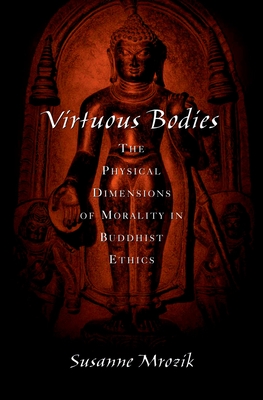
Virtuous Bodies : The Physical Dimensions of Morality in Buddhist Ethics
Book Details
Format
Hardback
Book Series
AAR Cultural Criticism Series
ISBN-10
0195305000
ISBN-13
9780195305005
Publisher
Oxford University Press Inc
Imprint
Oxford University Press Inc
Country of Manufacture
US
Country of Publication
GB
Publication Date
Jul 26th, 2007
Print length
200 Pages
Weight
468 grams
Dimensions
15.70 x 23.40 x 2.30 cms
Product Classification:
Ethics & moral philosophyBuddhism
KSh 9,600.00
Temporarily out of stock, due soon
0 in stock
Delivery Location
Delivery fee: Select location
Secure
Quality
Fast
Virtuous Bodies breaks new ground in the field of Buddhist ethics by investigating the diverse roles bodies play in ethical development. Traditionally, Buddhists assumed a close connection between body and morality. Thus Buddhist literature contains descriptions of living beings that stink with sin, are disfigured by vices, or are perfumed and adorned with virtues. Taking an influential early medieval Indian Mahāyāna Buddhist text-Śāntideva''s Compendium of Training (Śikşāsamuccaya)-as a case study, Susanne Mrozik demonstrates that Buddhists regarded ethical development as a process of physical and moral transformation. Mrozik chooses The Compendium of Training because it quotes from over one hundred Buddhist scriptures, allowing her to reveal a broader Buddhist interest in the ethical significance of bodies. The text is a training manual for bodhisattvas, especially monastic bodhisattvas. In it, bodies function as markers of, and conditions for, one''s own ethical development. Most strikingly, bodies also function as instruments for the ethical development of others. When living beings come into contact with the virtuous bodies of bodhisattvas, they are transformed physically and morally for the better. Virtuous Bodies explores both the centrality of bodies to the bodhisattva ideal and the corporeal specificity of that ideal. Arguing that the bodhisattva ideal is an embodied ethical ideal, Mrozik poses an array of fascinating questions: What does virtue look like? What kinds of physical features constitute virtuous bodies? What kinds of bodies have virtuous effects on others? Drawing on a range of contemporary theorists, this book engages in a feminist hermeneutics of recovery and suspicion in order to explore the ethical resources Buddhism offers to scholars and religious practitioners interested in the embodied nature of ethical ideals.
Virtuous Bodies breaks new ground in the field of Buddhist ethics by investigating the diverse roles bodies play in ethical development. Traditionally, Buddhists assumed a close connection between body and morality. Thus Buddhist literature contains descriptions of living beings that stink with sin, are disfigured by vices, or are perfumed and adorned with virtues. Taking an influential early medieval Indian Mahayana Buddhist text-Santideva's Compendium of Training (Siksasamuccaya)-as a case study, Susanne Mrozik demonstrates that Buddhists regarded ethical development as a process of physical and moral transformation. Mrozik chooses The Compendium of Training because it quotes from over one hundred Buddhist scriptures, allowing her to reveal a broader Buddhist interest in the ethical significance of bodies. The text is a training manual for bodhisattvas, especially monastic bodhisattvas. In it, bodies function as markers of, and conditions for, one's own ethical development. Most strikingly, bodies also function as instruments for the ethical development of others. When living beings come into contact with the virtuous bodies of bodhisattvas, they are transformed physically and morally for the better. Virtuous Bodies explores both the centrality of bodies to the bodhisattva ideal and the corporeal specificity of that ideal. Arguing that the bodhisattva ideal is an embodied ethical ideal, Mrozik poses an array of fascinating questions: What does virtue look like? What kinds of physical features constitute virtuous bodies? What kinds of bodies have virtuous effects on others? Drawing on a range of contemporary theorists, this book engages in a feminist hermeneutics of recovery and suspicion in order to explore the ethical resources Buddhism offers to scholars and religious practitioners interested in the embodied nature of ethical ideals.
Get Virtuous Bodies by Susanne Mrozik at the best price and quality guaranteed only at Werezi Africa's largest book ecommerce store. The book was published by Oxford University Press Inc and it has 200 pages.
Customers Who Bought This Also Bought
Xmeditations
KSh 700.00

Groundwork for the Metaphysics of Morals
KSh 2,000.00

On the Genealogy of Morals
KSh 2,000.00

Beyond Good and Evil
KSh 2,000.00
The Nicomachean Ethics
KSh 1,600.00

The Sovereignty of Good
KSh 5,400.00

Justice
KSh 2,000.00
Meditations
KSh 1,600.00
What We Owe The Future
KSh 2,000.00
The Analects
KSh 2,350.00

How to Be a Leader – An Ancient Guide to Wise Leadership
KSh 2,800.00

There Are Places in the World Where Rules Are Less Important Than Kindness
KSh 3,600.00
