
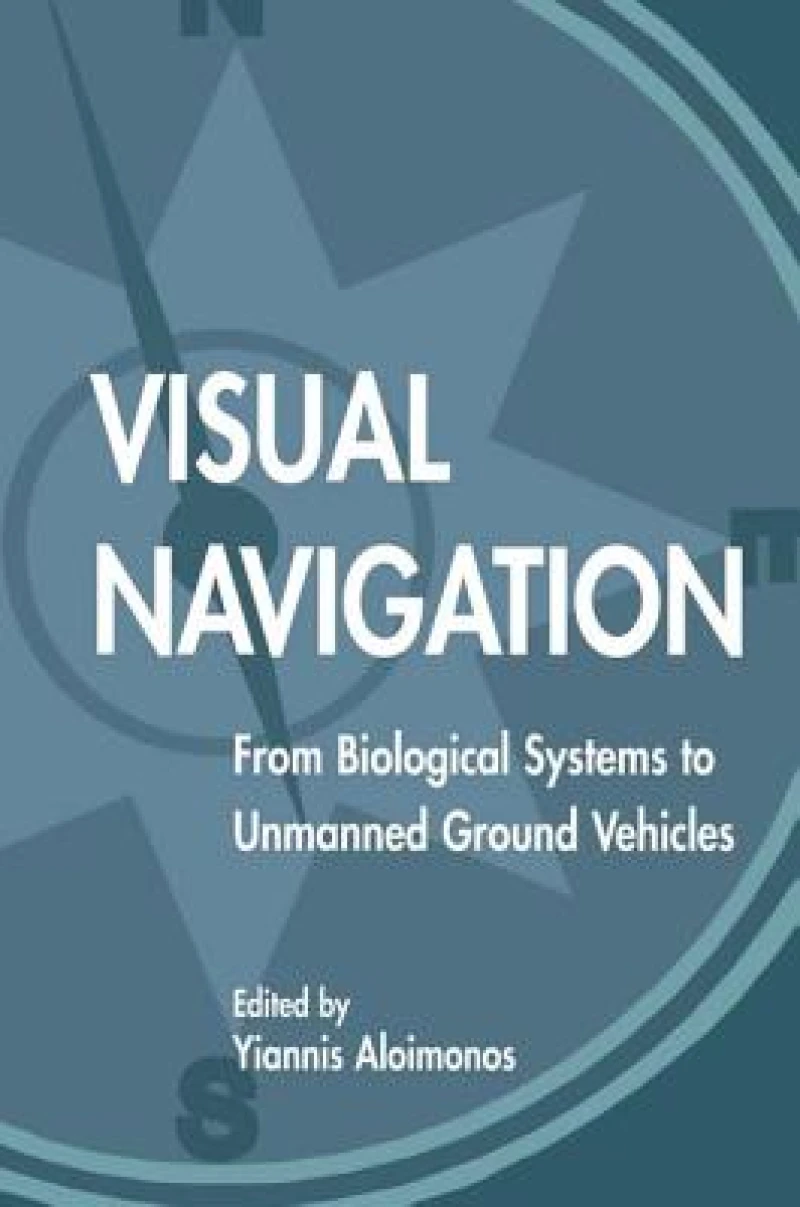
Visual Navigation : From Biological Systems To Unmanned Ground Vehicles
Book Details
Format
Paperback / Softback
Book Series
Computer Vision Series
ISBN-10
1138876542
ISBN-13
9781138876545
Publisher
Taylor & Francis Ltd
Imprint
Psychology Press Ltd
Country of Manufacture
GB
Country of Publication
GB
Publication Date
May 7th, 2015
Print length
430 Pages
Weight
612 grams
Product Classification:
Cognition and cognitive psychologyPerception
Ksh 9,500.00
Werezi Extended Catalogue
0 in stock
Delivery Location
Delivery fee: Select location
Secure
Quality
Fast
All biological systems with vision move about their environments and successfully perform many tasks. The same capabilities are needed in the world of robots. To that end, recent results in empirical fields that study insects and primates, as well as in theoretical and applied disciplines that design robots, have uncovered a number of the principles of navigation. To offer a unifying approach to the situation, this book brings together ideas from zoology, psychology, neurobiology, mathematics, geometry, computer science, and engineering. It contains theoretical developments that will be essential in future research on the topic -- especially new representations of space with less complexity than Euclidean representations possess. These representations allow biological and artificial systems to compute from images in order to successfully deal with their environments.
In this book, the barriers between different disciplines have been smoothed and the workings of vision systems of biological organisms are made clear in computational terms to computer scientists and engineers. At the same time, fundamental principles arising from computational considerations are made clear both to empirical scientists and engineers. Empiricists can generate a number of hypotheses that they could then study through various experiments. Engineers can gain insight for designing robotic systems that perceive aspects of their environment.
For the first time, readers will find:
* the insect vision system presented in a way that can be understood by computational scientists working in computer vision and engineering;
* three complete, working robotic navigation systems presented with all the issues related to their design analyzed in detail;
* the beginning of a computational theory of direct perception, as advocated by Gibson, presented in detail with applications for a variety of problems; and
* the idea that vision systems could compute space representations different from perfect metric descriptions -- and be used in robotic tasks -- advanced for both artificial and biological systems.
In this book, the barriers between different disciplines have been smoothed and the workings of vision systems of biological organisms are made clear in computational terms to computer scientists and engineers. At the same time, fundamental principles arising from computational considerations are made clear both to empirical scientists and engineers. Empiricists can generate a number of hypotheses that they could then study through various experiments. Engineers can gain insight for designing robotic systems that perceive aspects of their environment.
For the first time, readers will find:
* the insect vision system presented in a way that can be understood by computational scientists working in computer vision and engineering;
* three complete, working robotic navigation systems presented with all the issues related to their design analyzed in detail;
* the beginning of a computational theory of direct perception, as advocated by Gibson, presented in detail with applications for a variety of problems; and
* the idea that vision systems could compute space representations different from perfect metric descriptions -- and be used in robotic tasks -- advanced for both artificial and biological systems.
Get Visual Navigation by at the best price and quality guaranteed only at Werezi Africa's largest book ecommerce store. The book was published by Taylor & Francis Ltd and it has pages.

