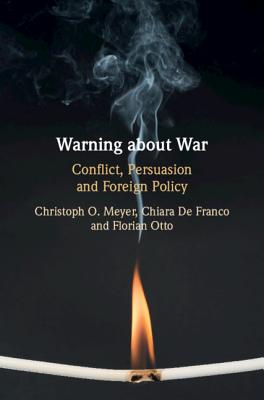
Warning about War : Conflict, Persuasion and Foreign Policy
Book Details
Format
Paperback / softback
ISBN-10
1108713939
ISBN-13
9781108713931
Publisher
Cambridge University Press
Imprint
Cambridge University Press
Country of Manufacture
GB
Country of Publication
GB
Publication Date
Jul 22nd, 2021
Print length
326 Pages
Weight
490 grams
Dimensions
15.20 x 22.80 x 2.40 cms
Product Classification:
Peace studies & conflict resolutionPeace studies and conflict resolutionSocial theoryPolitical ideologiesPolitical ideologies and movementsInternational relationsNon-governmental organizations (NGOs)International law: international disputes and civil procedureSettlement of international disputes
KSh 6,350.00
Currently unavailable
0 in stock
Delivery Location
Delivery fee: Select location
Secure
Quality
Fast
The authors develop a theoretical framework to explain how and when public and non-public warnings about future conflicts affect decision-making in Western states and international organisations. For scholars and practitioners working on conflict prevention, strategic surprise, and advocacy in peace, intelligence and communication studies.
What does it take for warnings about violent conflict and war to be listened to, believed and acted upon? Why are warnings from some sources noticed and largely accepted, while others are ignored or disbelieved? These questions are central to considering the feasibility of preventing harm to the economic and security interests of states. Challenging conventional accounts that tend to blame decision-makers'' lack of receptivity and political will, the authors offer a new theoretical framework explaining how distinct ''paths of persuasion'' are shaped by a select number of factors, including conflict characteristics, political contexts, and source-recipient relations. This is the first study to systematically integrate persuasion attempts by analysts, diplomats and senior officials with those by journalists and NGO staff. Its ambitious comparative design encompasses three states (the US, UK, and Germany) and international organisations (the UN, EU, and OSCE) and looks in depth at four conflict cases: Rwanda (1994), Darfur (2003), Georgia (2008) and Ukraine (2014).
Get Warning about War by Chiara De Franco, Christoph O. Meyer at the best price and quality guaranteed only at Werezi Africa's largest book ecommerce store. The book was published by Cambridge University Press and it has 326 pages.
Customers Who Bought This Also Bought

Letters to My Palestinian Neighbor
KSh 3,400.00

Leadership
KSh 2,700.00
Voices for Peace
KSh 2,000.00

What You Have Heard Is True
KSh 2,350.00

To Perpetual Peace
KSh 2,000.00

Thich Nhat Hanh 2026 Wall Calendar
KSh 2,150.00
Israel’s Palestinians
KSh 4,700.00

Routledge Handbook on China-Middle East Relations
KSh 9,250.00

The One State Reality
KSh 6,000.00
Coming Storm
KSh 3,950.00

How to Spot a Fascist
KSh 1,100.00
Israel’s Palestinians
KSh 8,800.00