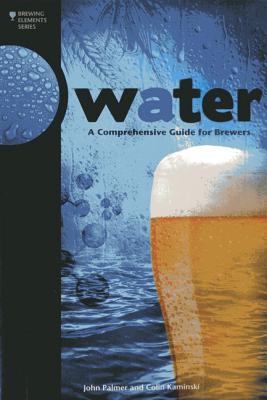
Water : A Comprehensive Guide for Brewers
Book Details
Format
Paperback / Softback
Book Series
Brewing Elements
ISBN-10
0937381993
ISBN-13
9780937381991
Publisher
Brewers Publications
Imprint
Brewers Publications
Country of Manufacture
US
Country of Publication
GB
Publication Date
Oct 7th, 2013
Print length
300 Pages
Weight
506 grams
Dimensions
22.40 x 15.20 x 1.90 cms
Product Classification:
Beverages
Ksh 2,700.00
Publisher Out of Stock
Delivery Location
Delivery fee: Select location
Secure
Quality
Fast
Water is arguably the most critical and least understood of the foundation elements in brewing. For many brewers used to choosing from a wide selection of hops and grain, water seems like an ingredient for which they have little choice but to accept what comes out of their faucet. But brewers in fact have many opportunities to modify their source water or to obtain mineral-free water and build their own brewing water from scratch. Much of the relevant information can be found in texts on physical and inorganic chemistry or water treatment and analysis, but these resources seldom, if ever, speak to brewers. Water: A Comprehensive Guide for Brewers takes the mystery out of water's role in the brewing process. This book is not just about brewing liquor. Whether in a brewery or at home, water is needed for every part of the brewing process: chilling, diluting, cleaning, boiler operation, wastewater treatment, and even physically pushing wort or beer from one place to another. The authors lead the reader from an overview of the water cycle and water sources, to adjusting water for different beer styles and brewery processes, to wastewater treatment. It covers precipitation, groundwater, and surface water, and explains how municipal water is treated to make it safe to drink but not always suitable for brewing. The parameters measured in a water report are explained, along with their impact on the mash and the final beer. Understand ion concentrations, temporary and permanent hardness, and pH. The concept of residual alkalinity is covered in detail and the causes of alkalinity in water are explored, along with techniques to control alkalinity. Ultimately, residual alkalinity is the major effector on mash pH, and this book addresses how to predict and target a specific mash pH—a key skill for any brewer wishing to raise their beer to the next level. But minerals in brewing water also determine specific flavor attributes. Ionic species important to beer are discussed and concepts like the sulfate-to-chloride ratio are explained. Examples illustrate how to tailor your brewing water to suit any style of beer. To complete the subject, the authors focus on brewery operations relating to source water treatment, such as the removal of particulates, dissolved solids, gas and liquid contaminants, organic contaminants, chlorine and chloramine, and dissolved oxygen. This section considers the pros and cons of various technologies, including membrane technologies such as filtration, ion-exchange systems, and reverse osmosis.
Water is arguably the most critical and least understood of the foundation elements in brewing. For many brewers used to choosing from a wide selection of hops and grain, water seems like an ingredient for which they have little choice but to accept what comes out of their faucet. But brewers in fact have many opportunities to modify their source water or to obtain mineral-free water and build their own brewing water from scratch. Much of the relevant information can be found in texts on physical and inorganic chemistry or water treatment and analysis, but these resources seldom, if ever, speak to brewers.
Water: A Comprehensive Guide for Brewers takes the mystery out of water''s role in the brewing process. This book is not just about brewing liquor. Whether in a brewery or at home, water is needed for every part of the brewing process: chilling, diluting, cleaning, boiler operation, wastewater treatment, and even physically pushing wort or beer from one place to another. The authors lead the reader from an overview of the water cycle and water sources, to adjusting water for different beer styles and brewery processes, to wastewater treatment.
It covers precipitation, groundwater, and surface water, and explains how municipal water is treated to make it safe to drink but not always suitable for brewing. The parameters measured in a water report are explained, along with their impact on the mash and the final beer. Understand ion concentrations, temporary and permanent hardness, and pH. The concept of residual alkalinity is covered in detail and the causes of alkalinity in water are explored, along with techniques to control alkalinity.
Ultimately, residual alkalinity is the major effector on mash pH, and this book addresses how to predict and target a specific mash pH—a key skill for any brewer wishing to raise their beer to the next level. But minerals in brewing water also determine specific flavor attributes. Ionic species important to beer are discussed and concepts like the sulfate-to-chloride ratio are explained. Examples illustrate how to tailor your brewing water to suit any style of beer.
To complete the subject, the authors focus on brewery operations relating to source water treatment, such as the removal of particulates, dissolved solids, gas and liquid contaminants, organic contaminants, chlorine and chloramine, and dissolved oxygen. This section considers the pros and cons of various technologies, including membrane technologies such as filtration, ion-exchange systems, and reverse osmosis.
Water: A Comprehensive Guide for Brewers takes the mystery out of water''s role in the brewing process. This book is not just about brewing liquor. Whether in a brewery or at home, water is needed for every part of the brewing process: chilling, diluting, cleaning, boiler operation, wastewater treatment, and even physically pushing wort or beer from one place to another. The authors lead the reader from an overview of the water cycle and water sources, to adjusting water for different beer styles and brewery processes, to wastewater treatment.
It covers precipitation, groundwater, and surface water, and explains how municipal water is treated to make it safe to drink but not always suitable for brewing. The parameters measured in a water report are explained, along with their impact on the mash and the final beer. Understand ion concentrations, temporary and permanent hardness, and pH. The concept of residual alkalinity is covered in detail and the causes of alkalinity in water are explored, along with techniques to control alkalinity.
Ultimately, residual alkalinity is the major effector on mash pH, and this book addresses how to predict and target a specific mash pH—a key skill for any brewer wishing to raise their beer to the next level. But minerals in brewing water also determine specific flavor attributes. Ionic species important to beer are discussed and concepts like the sulfate-to-chloride ratio are explained. Examples illustrate how to tailor your brewing water to suit any style of beer.
To complete the subject, the authors focus on brewery operations relating to source water treatment, such as the removal of particulates, dissolved solids, gas and liquid contaminants, organic contaminants, chlorine and chloramine, and dissolved oxygen. This section considers the pros and cons of various technologies, including membrane technologies such as filtration, ion-exchange systems, and reverse osmosis.
Get Water by at the best price and quality guaranteed only at Werezi Africa's largest book ecommerce store. The book was published by Brewers Publications and it has pages.