
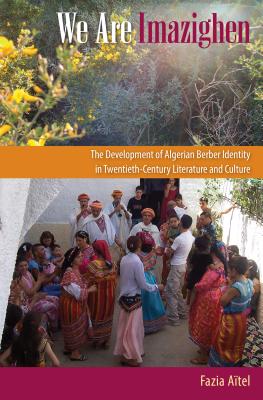
We Are Imazighen : The Development of Algerian Berber Identity in Twentieth-Century Literature and Culture
by
Fazia Aïtel
Book Details
Format
Hardback
ISBN-10
0813049393
ISBN-13
9780813049397
Publisher
University Press of Florida
Imprint
University Press of Florida
Country of Manufacture
US
Country of Publication
GB
Publication Date
Oct 30th, 2014
Print length
304 Pages
Weight
608 grams
Dimensions
16.10 x 23.70 x 2.10 cms
KSh 10,850.00
Temporarily out of stock, due soon
0 in stock
Delivery Location
Delivery fee: Select location
Secure
Quality
Fast
To the world they are known as Berbers, but they prefer to call themselves Imazighen, or “free people”. By tracing the cultural production of the Kabyle people—their songs, oral traditions, and literature—from the early 1930s to the end of the twentieth century, Fazia Aïtel shows how they have defined their own culture over time, both within Algeria and in its diaspora.
To the world they are known as Berbers, but they prefer to call themselves Imazighen, or “free people.” The claim to this unique cultural identity has been felt most acutely in Algeria in the Kabylia region, where an Amazigh consciousness gradually emerged after WWII. This is a valuable model for other Amazigh movements in North Africa, where the existence of an Amazigh language and culture is denied or dismissed in countries such as Morocco, Algeria, Tunisia, and Libya.
By tracing the cultural production of the Kabyle people—their songs, oral traditions, and literature—from the early 1930s to the end of the twentieth century, Fazia Aïtel shows how they have defined their own culture over time, both within Algeria and in its diaspora. She analyzes the role of Amazigh identity in the works of novelists such as Mouloud Feraoun, Tahar Djaout, and Assia Djebar, and she investigates the intersection of Amazigh consciousness and the Beur movement in France. She also addresses the political and social role of the Kabyles in Algeria and in France, where after independence it was easier for the Berber community to express and organize itself.
Ultimately, Aïtel argues that the Amazigh literary tradition is founded on dual priorities: the desire to foster a genuine dialogue while retaining a unique culture.
By tracing the cultural production of the Kabyle people—their songs, oral traditions, and literature—from the early 1930s to the end of the twentieth century, Fazia Aïtel shows how they have defined their own culture over time, both within Algeria and in its diaspora. She analyzes the role of Amazigh identity in the works of novelists such as Mouloud Feraoun, Tahar Djaout, and Assia Djebar, and she investigates the intersection of Amazigh consciousness and the Beur movement in France. She also addresses the political and social role of the Kabyles in Algeria and in France, where after independence it was easier for the Berber community to express and organize itself.
Ultimately, Aïtel argues that the Amazigh literary tradition is founded on dual priorities: the desire to foster a genuine dialogue while retaining a unique culture.
Get We Are Imazighen by Fazia Aïtel at the best price and quality guaranteed only at Werezi Africa's largest book ecommerce store. The book was published by University Press of Florida and it has 304 pages.
Customers Who Bought This Also Bought
Dreams in a Time of War
KSh 3,050.00
Modern Classics Penguin Essays of George Orwell
KSh 2,700.00

On Writing
KSh 2,000.00

To the Lighthouse
KSh 1,450.00
On Morrison
KSh 4,500.00

Africa''s Tarnished Name
KSh 700.00
C. S. Lewis
KSh 1,800.00

Life in Letters
KSh 5,400.00

By Grand Central Station I
KSh 1,800.00
Wide Sargasso Sea
KSh 1,800.00

Mom and Me and Mom
KSh 2,000.00
Jorge Luis Borges
KSh 1,800.00
