
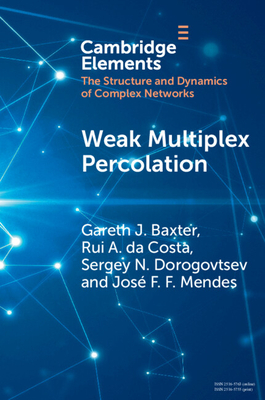
Weak Multiplex Percolation
Book Details
Format
Paperback / softback
ISBN-10
1108791077
ISBN-13
9781108791076
Publisher
Cambridge University Press
Imprint
Cambridge University Press
Country of Manufacture
GB
Country of Publication
GB
Publication Date
Jan 27th, 2022
Print length
374 Pages
Weight
92 grams
Dimensions
15.10 x 23.00 x 0.70 cms
KSh 3,250.00
Currently unavailable
0 in stock
Delivery Location
Delivery fee: Select location
Secure
Quality
Fast
In many systems consisting of interacting subsystems, the complex interactions between elements can be represented using multilayer networks. However, percolation is not trivially generalised to multiple layers. This Element describes a generalisation of percolation to multilayer networks: weak multiplex percolation.
In many systems consisting of interacting subsystems, the complex interactions between elements can be represented using multilayer networks. However percolation, key to understanding connectivity and robustness, is not trivially generalised to multiple layers. This Element describes a generalisation of percolation to multilayer networks: weak multiplex percolation. A node belongs to a connected component if at least one of its neighbours in each layer is in this component. The authors fully describe the critical phenomena of this process. In two layers with finite second moments of the degree distributions the authors observe an unusual continuous transition with quadratic growth above the threshold. When the second moments diverge, the singularity is determined by the asymptotics of the degree distributions, creating a rich set of critical behaviours. In three or more layers the authors find a discontinuous hybrid transition which persists even in highly heterogeneous degree distributions, becoming continuous only when the powerlaw exponent reaches $1+1/(M-1)$ for $M$ layers.
Get Weak Multiplex Percolation by Gareth J. Baxter, Jose F. F. Mendes at the best price and quality guaranteed only at Werezi Africa's largest book ecommerce store. The book was published by Cambridge University Press and it has 374 pages.
Customers Who Bought This Also Bought

The Random Number Code
KSh 36,000.00

Iteration Stable Tessellations
KSh 30,350.00

Monoidal Functors, Species and Hopf Algebras
KSh 27,200.00

Knapsack Problems
KSh 39,600.00
Introduction to Recognition and Deciphering of Patterns
KSh 9,700.00

Introduction to Data Science
KSh 24,300.00

The Baseball Mysteries
KSh 5,450.00

Basic Discrete Mathematics
KSh 11,700.00

New Digital Signal Processing Methods
KSh 25,200.00

The Shrikhande Graph
KSh 5,050.00

Neutrosophic Computing and Vague Data Analysis
KSh 22,500.00

Complexity and Evolution of Dissipative Systems
KSh 27,350.00