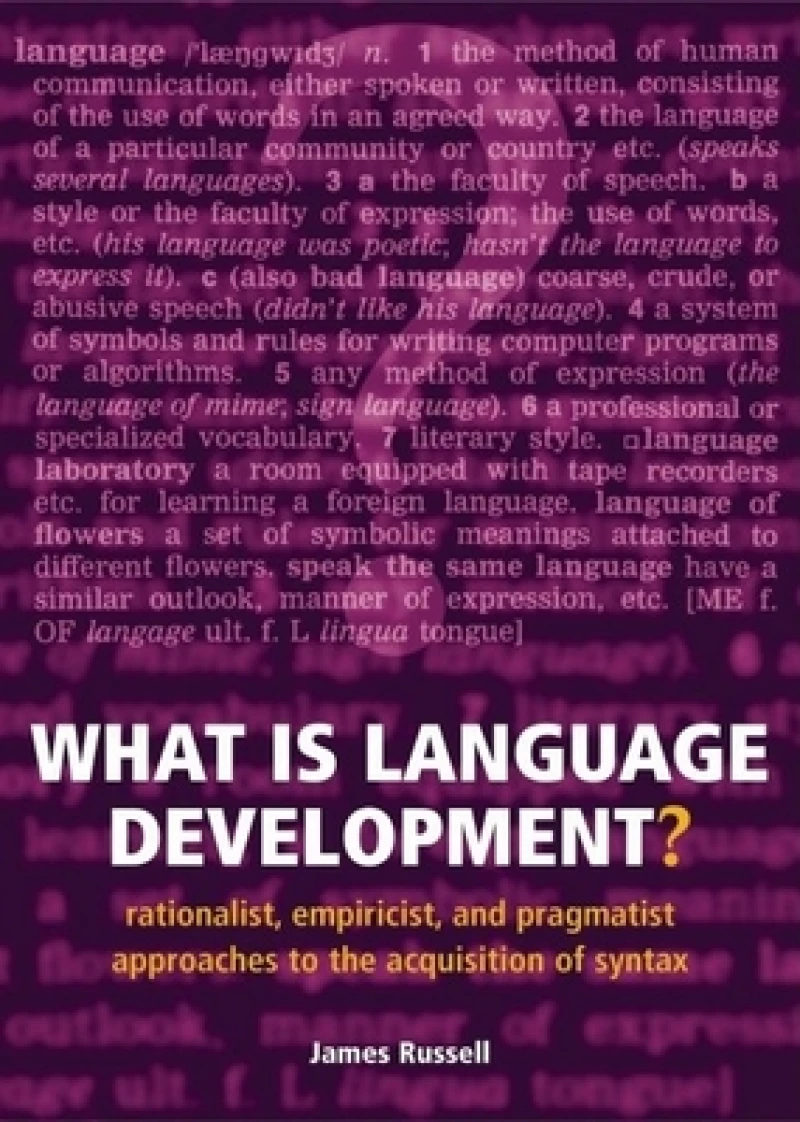
What is Language Development? : Rationalist, empiricist, and pragmatist approaches to the acquisition of syntax
Book Details
Format
Paperback / Softback
ISBN-10
0198530862
ISBN-13
9780198530862
Publisher
Oxford University Press
Imprint
Oxford University Press
Country of Manufacture
GB
Country of Publication
GB
Publication Date
Jul 8th, 2004
Print length
572 Pages
Weight
952 grams
Dimensions
23.90 x 16.90 x 3.30 cms
Ksh 16,300.00
Manufactured on Demand
0 in stock
Delivery Location
Delivery fee: Select location
Secure
Quality
Fast
Language development is one of the major battle grounds within the humanities and sciences. This book presents an account of the three dominant theories of language development.
Language development is one of the major battle grounds within the humanities and sciences. This is the first time that the three major theories in language development research have been fully described and compared within the covers of a single book. The three approaches: (1) The rationalism of Chomsky and the syntactic nativism that it entails; (2) The empiricism instinct in connectionist modelling of syntactic development; (3) The pragmatism of those who see the child as actively ''constructing'' a grammatical ''inventory'' piece-by-piece through recruiting general learning abilities and socio-cognitive knowledge. The book is unique in striking a balance between broad philosophical assessment of these three theories and fine-grain, fairly technical, accounts of how they fare at the empirical and linguistic ''coal faces''.In Part 1, the kind of psychology to which rationalism, empiricism, and pragmatism give rise are described with reference to philosophers such as Fodor, Hume, and the American pragmatists from Peirce, to Rorty and Brandom. After an introduction to the syntactic analysis of the sentence, Part 2 continues with an account of the evolution of Chomskyan theory from its inception to the present day, followed by a review of developmental research inspired by it. Part 3 takes a sceptical look at connectionist modelling of syntactic development. Part 4 describes the kind of linguistic theories that the socio-cognitive approach finds sympathetic, reviewing its empirical progress (e.g. the work of Tomasello), ending with a comparison of how the generativists and functionalists tackle the evolution of syntax.Clearly and accessibly written, the book will be an important text for developmental psychologists, linguists, and philosophers working on language.
Get What is Language Development? by at the best price and quality guaranteed only at Werezi Africa's largest book ecommerce store. The book was published by Oxford University Press and it has pages.