
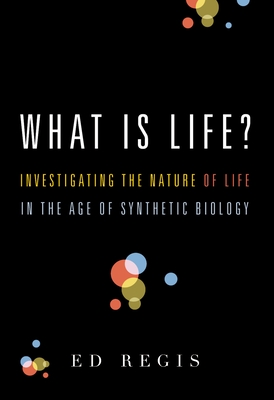
What Is Life? : Investigating the Nature of Life in the Age of Synthetic Biology
by
Ed. Regis
Book Details
Format
Paperback / softback
ISBN-10
0195383419
ISBN-13
9780195383416
Publisher
Oxford University Press Inc
Imprint
Oxford University Press Inc
Country of Manufacture
GB
Country of Publication
GB
Publication Date
Jul 23rd, 2009
Print length
208 Pages
Weight
262 grams
Dimensions
20.30 x 13.50 x 1.30 cms
Product Classification:
Popular scienceEvolution
KSh 2,700.00
Currently unavailable
0 in stock
Delivery Location
Delivery fee: Select location
Secure
Quality
Fast
Erwin Schrödinger's 1944 classic What Is Life? is a small book that occupies a large place among the great written works of the twentieth century. It is said that it helped launch the modern revolution in biology and genetics, and inspired a generation of scientists, including Watson and Crick, to explore the riddle of life itself. Now, more than sixty years later, science writer Ed Regis offers an intriguing look at where this quest stands today. Regis ranges widely here, illuminating many diverse efforts to solve one of science's great mysteries. He examines the genesis of Schrödinger's great book--which first debuted as three public lectures in Dublin--and details the fantastic reception his ideas received, both in Europe and America. Regis also introduces us to the work of a remarkable group of scientists who are attempting literally to create life from scratch, starting with molecular components that they hope to assemble into the world's first synthetic living cell. The book also examines how scientists have unlocked the "three secrets of life," describes the key role played by ATP ("the ultimate driving force of all life"), and outlines the many attempts to explain how life first arose on earth, a puzzle that has given birth to a wide range of theories (which Francis Crick dismissed as "too much speculation running after too few facts"), from the primordial sandwich theory, to the theory that life arose in clay, in deep-sea vents, or in oily bubbles at the seashore, right up to Freeman Dyson's "theory of double origins." Written in a lively and accessible style, and bringing together a wide range of cutting-edge research, What is Life? makes an illuminating contribution to this ancient and ever-fascinating debate.
Erwin Schrödinger''s 1944 classic What Is Life? is a small book that occupies a large place among the great written works of the twentieth century. It is said that it helped launch the modern revolution in biology and genetics, and inspired a generation of scientists, including Watson and Crick, to explore the riddle of life itself. Now, more than sixty years later, science writer Ed Regis offers an intriguing look at where this quest stands today. Regis ranges widely here, illuminating many diverse efforts to solve one of science''s great mysteries. He examines the genesis of Schrödinger''s great book--which first debuted as three public lectures in Dublin--and details the fantastic reception his ideas received, both in Europe and America. Regis also introduces us to the work of a remarkable group of scientists who are attempting literally to create life from scratch, starting with molecular components that they hope to assemble into the world''s first synthetic living cell. The book also examines how scientists have unlocked the "three secrets of life," describes the key role played by ATP ("the ultimate driving force of all life"), and outlines the many attempts to explain how life first arose on earth, a puzzle that has given birth to a wide range of theories (which Francis Crick dismissed as "too much speculation running after too few facts"), from the primordial sandwich theory, to the theory that life arose in clay, in deep-sea vents, or in oily bubbles at the seashore, right up to Freeman Dyson''s "theory of double origins." Written in a lively and accessible style, and bringing together a wide range of cutting-edge research, What is Life? makes an illuminating contribution to this ancient and ever-fascinating debate.
Get What Is Life? by Ed. Regis at the best price and quality guaranteed only at Werezi Africa's largest book ecommerce store. The book was published by Oxford University Press Inc and it has 208 pages.
Customers Who Bought This Also Bought

Nexus
KSh 2,350.00
A Brief History of Time
KSh 3,950.00
Sapiens
KSh 2,350.00
What If?
KSh 2,350.00
Brain That Changes Itself
KSh 2,350.00
Power of Habit
KSh 2,150.00

Seven Brief Lessons on Physics
KSh 2,350.00
Order of Time
KSh 2,350.00
Seven Brief Lessons on Physics
KSh 1,800.00
Predictably Irrational
KSh 2,000.00
Insect Crisis
KSh 2,350.00
Reality Is Not What It Seems
KSh 2,350.00
