
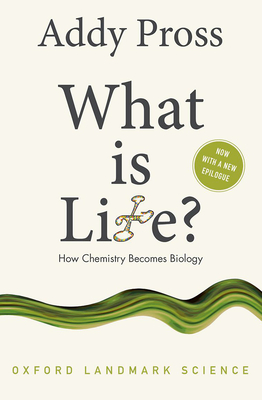
What is Life? : How Chemistry Becomes Biology
by
Addy Pross
Book Details
Format
Paperback / softback
Book Series
Oxford Landmark Science
ISBN-10
0198784791
ISBN-13
9780198784791
Publisher
Oxford University Press
Imprint
Oxford University Press
Country of Manufacture
GB
Country of Publication
GB
Publication Date
Apr 28th, 2016
Print length
224 Pages
Weight
170 grams
Dimensions
12.90 x 19.70 x 1.60 cms
Product Classification:
Popular scienceChemistryEvolutionEvolution / Evolutionary biology
KSh 2,350.00
Werezi Extended Catalogue
Delivery in 12 days
1 copies in stock
Delivery Location
Delivery fee: Select location
Delivery in 12 days
Secure
Quality
Fast
Seventy years ago, Erwin Schrödinger posed a profound question: 'What is life, and how did it emerge from non-life?' Scientists have puzzled over it ever since. Addy Pross uses insights from the new field of systems chemistry to show how chemistry can become biology, and that Darwinian evolution is the expression of a deeper physical principle.
Seventy years ago, Erwin Schrödinger posed a profound question: ''What is life, and how did it emerge from non-life?'' This problem has puzzled biologists and physical scientists ever since. Living things are hugely complex and have unique properties, such as self-maintenance and apparently purposeful behaviour which we do not see in inert matter. So how does chemistry give rise to biology? What could have led the first replicating molecules up such a path? Now, developments in the emerging field of ''systems chemistry'' are unlocking the problem. Addy Pross shows how the different kind of stability that operates among replicating molecules results in a tendency for chemical systems to become more complex and acquire the properties of life. Strikingly, he demonstrates that Darwinian evolution is the biological expression of a deeper, well-defined chemical concept: the whole story from replicating molecules to complex life is one continuous process governed by an underlying physical principle. The gulf between biology and the physical sciences is finally becoming bridged.This new edition includes an Epilogue describing developments in the concepts of fundamental forms of stability discussed in the book, and their profound implications.Oxford Landmark Science books are ''must-read'' classics of modern science writing which have crystallized big ideas, and shaped the way we think.
Get What is Life? by Addy Pross at the best price and quality guaranteed only at Werezi Africa's largest book ecommerce store. The book was published by Oxford University Press and it has 224 pages.
Customers Who Bought This Also Bought

Nexus
KSh 2,350.00
A Brief History of Time
KSh 3,950.00
Sapiens
KSh 2,350.00
What If?
KSh 2,350.00
Brain That Changes Itself
KSh 2,350.00
Power of Habit
KSh 2,150.00

Seven Brief Lessons on Physics
KSh 2,350.00
Order of Time
KSh 2,350.00
Seven Brief Lessons on Physics
KSh 1,800.00
Predictably Irrational
KSh 2,000.00
Insect Crisis
KSh 2,350.00
Reality Is Not What It Seems
KSh 2,350.00