
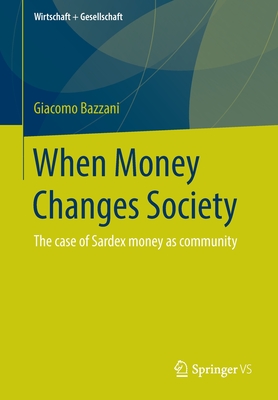
Book Details
Format
Paperback / softback
Book Series
Wirtschaft + Gesellschaft
ISBN-10
365828532X
ISBN-13
9783658285326
Edition
2020 ed.
Publisher
Springer Fachmedien Wiesbaden
Imprint
Springer VS
Country of Manufacture
GB
Country of Publication
GB
Publication Date
May 10th, 2020
Print length
189 Pages
Product Classification:
Sociology: work & labourSociology: work and labour
KSh 8,100.00
Currently unavailable
0 in stock
Delivery Location
Delivery fee: Select location
Secure
Quality
Fast
Classical sociology considered money as central to the functioning of modern society, relating
it to a progressive expansion of instrumental rationality and the emergence of weaker social ties.
Modern money, the universal equivalent described by Simmel, facilitates the
exchange of goods and values by providing a single unit of account. This "frees" people and things
from traditional social ties and makes them free to "sell" their work and trade goods on markets that
increasingly erode national borders. Modern money thus frees the individual from traditional social
ties and facilitates the creation of ever larger and more inter-connected markets. Sardex money, on
the other hand, seems to work in the opposite direction: the weak social ties of ordinary economic
transactions are replaced by strong ones, characterised by a high level of reciprocity and by an ethical code. Furthermore the movement of goods is restricted to the regional level and much is
done to promote economic exchanges between member companies.
Get When Money Changes Society by Giacomo Bazzani at the best price and quality guaranteed only at Werezi Africa's largest book ecommerce store. The book was published by Springer Fachmedien Wiesbaden and it has 189 pages.
Customers Who Bought This Also Bought

What Should I Do With My Life?
KSh 3,400.00

The Reverse Centaur's Guide to Life After AI
KSh 3,050.00

The Unfair Advantage
KSh 2,000.00

Chokepoint Capitalism
KSh 2,000.00
Making Africa Work
KSh 4,500.00
Faces of Precarity – Critical Perspectives on Work , Subjectivities and Struggles
KSh 13,150.00

Uncommon People
KSh 2,700.00
Hope and Danger in the New South City
KSh 7,500.00
Planet Work – Rethinking Labor and Leisure in the Anthropocene
KSh 22,300.00

Making Freedom Pay
KSh 5,750.00

Victory at Home
KSh 6,000.00

Glass Ceilings and 100-Hour Couples
KSh 5,050.00
