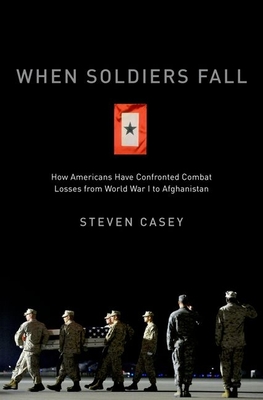
When Soldiers Fall : How Americans Have Confronted Combat Losses from World War I to Afghanistan
by
Steven Casey
Book Details
Format
Hardback
ISBN-10
0199890382
ISBN-13
9780199890385
Publisher
Oxford University Press Inc
Imprint
Oxford University Press Inc
Country of Manufacture
GB
Country of Publication
GB
Publication Date
Jan 23rd, 2014
Print length
320 Pages
Weight
552 grams
Dimensions
24.30 x 15.50 x 2.60 cms
KSh 8,850.00
Currently unavailable
0 in stock
Delivery Location
Delivery fee: Select location
Secure
Quality
Fast
When Soldiers Fall traces the history of American combat losses and the ways in which the government has reported casualties from WWI to the current War on Terror.
The extent to which combat casualties influence the public''s support for war is one of the most frequently and fiercely debated subjects in current American life and has cast an enormous shadow over both the Iraq and Afghanistan conflicts. The common assumption, based largely on U.S. experience in past wars, is that the public is in some way casualty averse or casualty shy, and that as losses increase its support for a war will inexorably decline. Yet this assumption has been adopted as conventional wisdom without any awareness of one of the most important dimensions of the issue: how has the public become aware of the casualties sustained during particular wars? To what extent has the government tried to manipulate or massage the figures? When and why have these official figures been challenged by opportunistic political opponents or aggressive scoop-seeking reporters? As Steven Casey demonstrates, at key moments in most wars what the public actually receives is not straightforward and accurate casualty totals, but an enormous amount of noise based on a mixture of suppression, suspicion, and speculation. This book aims to correct this gap in information by showing precise what casualty figures the government announced during its various wars, the timing of these announcements, and any spin officials may have placed upon these, using a range of hitherto untapped primary documents. Among the nuggets he has uncovered is that during World War I the media depended on Axis figures and that the Army and Navy did not announce casualty figures for an entire year during World War II. Organized chronologically, the book addresses the two world wars, the limited wars in Korea and Vietnam, and the recent conflicts that are part of the War on Terror. Using sources such as the private military command papers of Generals Patton, MacArthur, and Westmoreland, and previously unopened New York Times archives, it offers the first analysis of how the U.S. government has publicized combat casualties during these wars, and how these official announcements have been debated and disputed by other voices in the polity. Casey discusses factors such as changes of presidential administration, the improvement of technology, the sending of war correspondents to cover multiple conflicts, and the increasing ability to identify bodies. Casey recreates the complicated controversies that have surrounded key battles, and in doing so challenges the simplicity of the oft-repeated conventional wisdom that "as casualties mount, support decreases. " By integrating military and political history, he presents a totally new interpretation of U.S. domestic propaganda since 1917, filling a major gap left by a spate of recent books. Finally, it provides a fresh and engaging new perspective on some of the biggest battles in recent American history, including the Meuse-Argonne, D-Day, the Battle of the Bulge, China''s intervention in the Korean War, the Tet Offensive, and the recent campaigns in Iraq and Afghanistan.This book should speak to the military, political, and media history markets, and it should also reach a wider audience that is debating contemporary casualty figures.
Get When Soldiers Fall by Steven Casey at the best price and quality guaranteed only at Werezi Africa's largest book ecommerce store. The book was published by Oxford University Press Inc and it has 320 pages.
Customers Who Bought This Also Bought
Crusade for Justice – The Autobiography of Ida B. Wells, Second Edition
KSh 4,050.00

Killers of the Flower Moon
KSh 2,000.00

Warmth of Other Suns
KSh 3,050.00
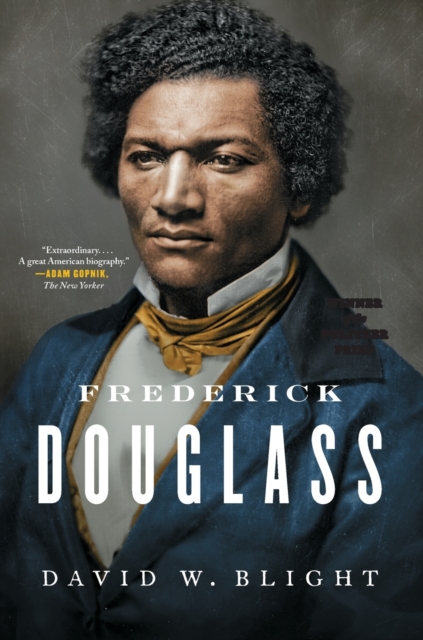
Frederick Douglass
KSh 3,350.00
107 Days
KSh 4,500.00

Second Treatise of Government – Norton Library
KSh 1,600.00

Tuesdays With Morrie
KSh 2,000.00
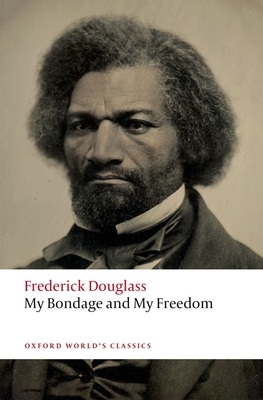
My Bondage and My Freedom
KSh 1,600.00

Hidden Figures
KSh 2,000.00
America, América
KSh 3,650.00
Holding the Line
KSh 2,000.00
Nuclear Folly
KSh 3,050.00