

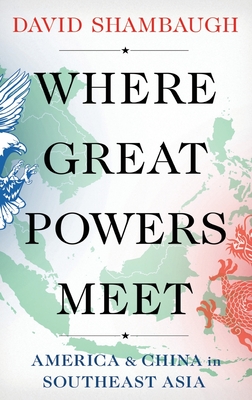
Where Great Powers Meet : America & China in Southeast Asia
Book Details
Format
Paperback / softback
ISBN-10
0197667341
ISBN-13
9780197667347
Publisher
Oxford University Press Inc
Imprint
Oxford University Press Inc
Country of Manufacture
GB
Country of Publication
GB
Publication Date
Nov 14th, 2022
Print length
352 Pages
Weight
512 grams
Dimensions
15.60 x 23.60 x 2.30 cms
KSh 4,100.00
Manufactured on Demand
Delivery in 49 days
1 copies in stock
Delivery Location
Delivery fee: Select location
Delivery in 49 days
Secure
Quality
Fast
Where Great Powers Meet explores the global competition for power between the United States and China. Focusing on Southeast Asia, David Shambaugh looks at how ASEAN (the Association of Southeast Asian Nations) and the countries within it maneuver between the US and China and the degree to which they align with one or the other power.
After the end of the Cold War, it seemed as if Southeast Asia would remain a geopolitically stable region within the American-led order for the foreseeable future. In the last two decades, however, the re-emergence of China as a major great power has called into question the geopolitical future of the region and raised the specter of renewed great power competition. As the eminent China scholar David Shambaugh explains in Where Great Powers Meet, the United States and China are engaged in a broad-gauged and global competition for power. While this competition ranges across the entire world, it is centered in Asia. In this book, Shambaugh focuses on the critical sub-region of Southeast Asia. The United States and China constantly vie for position and influence across this enormously significant area--and the outcome of this contest will do much to determine whether Asia leaves the American orbit after seven decades and falls into a new Chinese sphere of influence. Just as importantly, to the extent that there is a global "power transition" occurring from the US to China, the fate of Southeast Asia will be a good indicator. Presently, both powers bring important assets to bear in their competition. The United States continues to possess a depth and breadth of security ties, soft power, and direct investment across the region that empirically outweigh China''s. For its part, China has more diplomatic influence, much greater trade, and geographic proximity. In assessing the likelihood of a regional power transition, Shambaugh examines how ASEAN (the Association of Southeast Asian Nations) and its member states maneuver and the degree to which they align with one or the other power.
Get Where Great Powers Meet by David Shambaugh at the best price and quality guaranteed only at Werezi Africa's largest book ecommerce store. The book was published by Oxford University Press Inc and it has 352 pages.
Customers Who Bought This Also Bought
Decolonizing Language and Other Revolutionary Ideas
KSh 2,350.00

Homecoming
KSh 1,800.00
Decolonizing Language and Other Revolutionary Ideas
KSh 3,600.00

How Europe Underdeveloped Africa
KSh 3,250.00

Crusade for Justice – The Autobiography of Ida B. Wells, Second Edition
KSh 4,050.00

Message
KSh 3,400.00

Finding Me
KSh 2,350.00

Autobiography of Malcolm X
KSh 2,350.00

In the Wake
KSh 3,600.00

I Know Why The Caged Bird Sings
KSh 2,000.00

Black Women Writers at Work
KSh 3,600.00

Stranger Faces
KSh 2,500.00
More by David Shambaugh
China's Communist Party
KSh 4,500.00
China's Leaders – From Mao to Now
KSh 11,700.00
Modernizing China's Military
KSh 5,400.00

The Odyssey of China''s Imperial Art Treasures
KSh 6,600.00
Beautiful Imperialist
KSh 10,800.00

Breaking the Engagement
KSh 5,000.00

China's Leaders
KSh 3,250.00
Where Great Powers Meet
KSh 5,800.00
More in This Genre
Decolonizing Language and Other Revolutionary Ideas
KSh 2,350.00
Homecoming
KSh 1,800.00
Decolonizing Language and Other Revolutionary Ideas
KSh 3,600.00
How Europe Underdeveloped Africa
KSh 3,250.00
Crusade for Justice – The Autobiography of Ida B. Wells, Second Edition
KSh 4,050.00
Message
KSh 3,400.00
