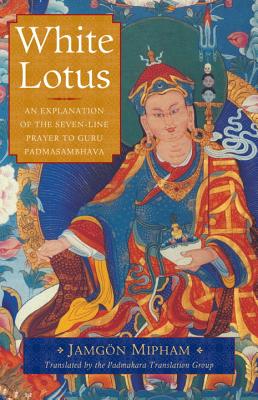
White Lotus : An Explanation of the Seven-Line Prayer to Guru Padmasambhava
Book Details
Format
Paperback / softback
ISBN-10
1611802938
ISBN-13
9781611802931
Publisher
Shambhala Publications Inc
Imprint
Shambhala Publications Inc
Country of Manufacture
US
Country of Publication
GB
Publication Date
Sep 1st, 2015
Print length
144 Pages
Weight
164 grams
Dimensions
12.90 x 19.60 x 1.50 cms
Product Classification:
BuddhismTibetan BuddhismBuddhismTibetan Buddhism
KSh 3,050.00
Werezi Extended Catalogue
Delivery in 12 days
1 copies in stock
Delivery Location
Delivery fee: Select location
Delivery in 12 days
Secure
Quality
Fast
The commentary translated in these pages is unusual and rare. But if the commentary is a rarity, its subject matter—the seven-line invocation of Padmasambhava—is one of the best-known prayers in the Tibetan Buddhist world.
The overall significance of the Seven-Line Prayer is perhaps best appreciated in relation to a practice called guru-yoga, or "union with the nature of the guru." The purpose of guru-yoga is to purify and deepen the student''s relationship with his or her teacher. It is introduced as one of the preliminary practices, and it remains crucial—in fact, its importance increases—as one progresses through the more advanced levels of the tantric path. The cultivation of devotion to the guru and the blending of one''s mind with his or her enlightened mind is, in the words of Dilgo Khyentse Rinpoche, "the most vital and necessary of all practices and is in itself the surest and fastest way to reach the goal of enlightenment."
Regarding the origin of this commentary, Mipham refers in the colophon to an event that triggered the abrupt appearance in his mind of the hidden meaning of the prayer. It is interesting to note that the language Mipham uses suggests that the commentary itself is not an ordinary composition but perhaps a treasure teaching, specifically a "mind-treasure" or gongter.
The overall significance of the Seven-Line Prayer is perhaps best appreciated in relation to a practice called guru-yoga, or "union with the nature of the guru." The purpose of guru-yoga is to purify and deepen the student''s relationship with his or her teacher. It is introduced as one of the preliminary practices, and it remains crucial—in fact, its importance increases—as one progresses through the more advanced levels of the tantric path. The cultivation of devotion to the guru and the blending of one''s mind with his or her enlightened mind is, in the words of Dilgo Khyentse Rinpoche, "the most vital and necessary of all practices and is in itself the surest and fastest way to reach the goal of enlightenment."
Regarding the origin of this commentary, Mipham refers in the colophon to an event that triggered the abrupt appearance in his mind of the hidden meaning of the prayer. It is interesting to note that the language Mipham uses suggests that the commentary itself is not an ordinary composition but perhaps a treasure teaching, specifically a "mind-treasure" or gongter.
Get White Lotus by Jamgon Mipham at the best price and quality guaranteed only at Werezi Africa's largest book ecommerce store. The book was published by Shambhala Publications Inc and it has 144 pages.
Customers Who Bought This Also Bought

Comfortable with Uncertainty
KSh 3,050.00
Buddhist Scriptures
KSh 2,700.00

Peace Is Every Step
KSh 2,700.00

Wisdom of No Escape
KSh 1,800.00
Practicing Dying
KSh 2,250.00

Path With Heart
KSh 3,600.00

Anger
KSh 3,050.00
The Philosophy of the Bhagavad-Gita
KSh 16,200.00
The Snail is Slow but Never Late
KSh 3,050.00
Esoteric Buddhism in China
KSh 5,400.00

When Things Don’t Go Your Way
KSh 2,350.00
How to Be Caring – An Ancient Guide to a Compassionate Life
KSh 2,700.00