
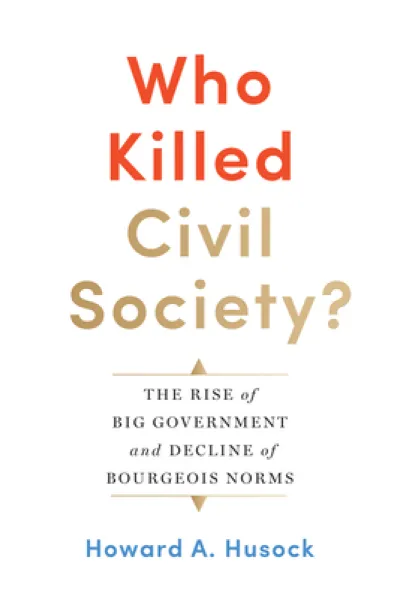
Who Killed Civil Society? : The Rise of Big Government and Decline of Bourgeois Norms
Book Details
Format
Hardback or Cased Book
ISBN-10
1641770589
ISBN-13
9781641770583
Publisher
Encounter Books,USA
Imprint
Encounter Books,USA
Country of Manufacture
US
Country of Publication
GB
Publication Date
Oct 24th, 2019
Print length
176 Pages
Weight
420 grams
Dimensions
16.10 x 23.60 x 2.00 cms
Product Classification:
Charities, voluntary services & philanthropyPublic administrationCentral government policies
Ksh 3,250.00
Re-Printing
Delivery in 14 days
1 copies in stock
Delivery Location
Delivery fee: Select location
Delivery in 14 days
Secure
Quality
Fast
Vexing social issues such as the opioid epidemic, criminal violence, and chronic unemployment are the target of social programs Americans fund with their tax dollars. Husock argues that over the past century, the U.S. has lost sight of the more powerful antidote to these problems: positive social norms.
Billions of American tax dollars go into a vast array of programs targeting various social issues: the opioid epidemic, criminal violence, chronic unemployment, and so on. Yet the problems persist and even grow. Howard Husock argues that we have lost sight of a more powerful strategy—a preventive strategy, based on positive social norms.
In the past, individuals and institutions of civil society actively promoted what may be called “bourgeois norms,” to nurture healthy habits so that social problems wouldn’t emerge in the first place. It was a formative effort. Today, a massive social service state instead takes a reformative approach to problems that have already become vexing. It offers counseling along with material support, but struggling communities have been more harmed than helped by government’s embrace. And social service agencies have a vested interest in the continuance of problems.
Government can provide a financial safety net for citizens, but it cannot effectively create or promote healthy norms. Nor should it try. That formative work is best done by civil society.
This book focuses on six key figures in the history of social welfare to illuminate how a norm-promoting culture was built, then lost, and how it can be revived. We read about Charles Loring Brace, founder of the Children’s Aid Society; Jane Addams, founder of Hull House; Mary Richmond, a social work pioneer; Grace Abbott of the federal Children’s Bureau; Wilbur Cohen of the Department of Health, Education and Welfare; and Geoffrey Canada, founder of the Harlem Children’s Zone—a model for bringing real benefit to a poor community through positive social norms. We need more like it.
In the past, individuals and institutions of civil society actively promoted what may be called “bourgeois norms,” to nurture healthy habits so that social problems wouldn’t emerge in the first place. It was a formative effort. Today, a massive social service state instead takes a reformative approach to problems that have already become vexing. It offers counseling along with material support, but struggling communities have been more harmed than helped by government’s embrace. And social service agencies have a vested interest in the continuance of problems.
Government can provide a financial safety net for citizens, but it cannot effectively create or promote healthy norms. Nor should it try. That formative work is best done by civil society.
This book focuses on six key figures in the history of social welfare to illuminate how a norm-promoting culture was built, then lost, and how it can be revived. We read about Charles Loring Brace, founder of the Children’s Aid Society; Jane Addams, founder of Hull House; Mary Richmond, a social work pioneer; Grace Abbott of the federal Children’s Bureau; Wilbur Cohen of the Department of Health, Education and Welfare; and Geoffrey Canada, founder of the Harlem Children’s Zone—a model for bringing real benefit to a poor community through positive social norms. We need more like it.
Get Who Killed Civil Society? by at the best price and quality guaranteed only at Werezi Africa's largest book ecommerce store. The book was published by Encounter Books,USA and it has pages.

