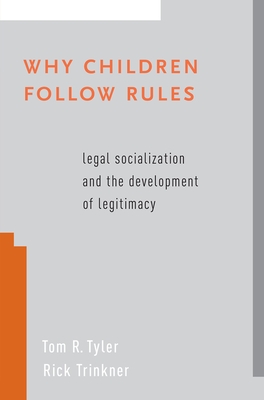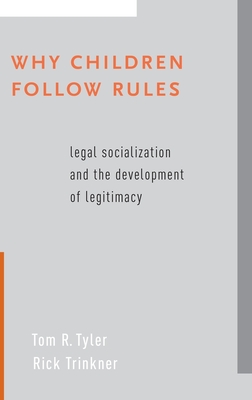
Why Children Follow Rules : Legal Socialization and the Development of Legitimacy
Book Details
Format
Hardback
ISBN-10
0190644141
ISBN-13
9780190644147
Publisher
Oxford University Press Inc
Imprint
Oxford University Press Inc
Country of Manufacture
US
Country of Publication
GB
Publication Date
Feb 22nd, 2018
Print length
280 Pages
Weight
508 grams
Dimensions
16.60 x 24.40 x 2.70 cms
Product Classification:
SociologySocial workJuvenile offendersChild & developmental psychologyLaw & society
KSh 11,050.00
Currently unavailable
0 in stock
Delivery Location
Delivery fee: Select location
Secure
Quality
Fast
Why Children Follow Rules focuses on the process by which children and adolescents develop their orientation toward the law. Drawing on law, psychology, sociology and criminology, Tom Tyler and Rick Trinkner review the literature on socialization with a particular focus on families, schools, and the juvenile justice to reveal a fundamental conflict about how authority and power should be exercised in essential social institutions. They argue for the merits of consensual authority as a way to foster the popular legitimacy of the law at a time when public trust in the police, courts, and the law has reached unsettling lows.
Legal socialization is the process by which children and adolescents acquire their law related values, attitudes, and reasoning capacities. Such values and attitudes, in particular legitimacy, underlie the ability and willingness to consent to laws and defer to legal authorities that make legitimacy based legal systems possible. By age eighteen a person''s orientation toward law is largely established, yet legal scholarship has largely ignored this process in favor of studying adults and their relationship to the law. Why Children Follow Rules focuses upon legal socialization outlining what is known about the process across three related, but distinct, contexts: the family, the school, and the juvenile justice system. Throughout, Tom Tyler and Rick Trinkner emphasize the degree to which individuals develop their orientations toward law and legal authority upon values connected to responsibility and obligation as opposed to fear of punishment. They argue that authorities can act in ways that internalize legal values and promote supportive attitudes. In particular, consensual legal authority is linked to three issues: how authorities make decisions, how they treat people, and whether they recognize the boundaries of their authority. When individuals experience authority that is fair, respectful, and aware of the limits of power, they are more likely to consent and follow directives. Despite clear evidence showing the benefits of consensual authority, strong pressures and popular support for the exercise of authority based on dominance and force persist in America''s families, schools, and within the juvenile justice system. As the currently low levels of public trust and confidence in the police, the courts, and the law undermine the effectiveness of our legal system, Tom Tyler and Rick Trinkner point to alternative way to foster the popular legitimacy of the law in an era of mistrust.
Get Why Children Follow Rules by Rick Trinkner, Tom R. Tyler at the best price and quality guaranteed only at Werezi Africa's largest book ecommerce store. The book was published by Oxford University Press Inc and it has 280 pages.
Customers Who Bought This Also Bought

Caste
KSh 2,700.00

On Freedom
KSh 2,350.00

Extinction of Experience
KSh 3,950.00

Revenge of the Tipping Point
KSh 2,350.00

Lost Girls
KSh 2,000.00

Right to Sex
KSh 2,000.00

Caste
KSh 4,550.00

Revenge of the Tipping Point
KSh 4,500.00

Revenge of the Tipping Point
KSh 3,050.00

Can Feminism Be African
KSh 2,000.00

Can Feminism Be African
KSh 3,950.00

History of Sexuality: 2
KSh 2,350.00