
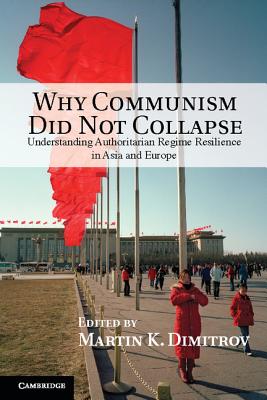
Why Communism Did Not Collapse : Understanding Authoritarian Regime Resilience in Asia and Europe
Book Details
Format
Paperback / softback
ISBN-10
1107651131
ISBN-13
9781107651135
Publisher
Cambridge University Press
Imprint
Cambridge University Press
Country of Manufacture
GB
Country of Publication
GB
Publication Date
Aug 6th, 2013
Print length
390 Pages
Weight
534 grams
Dimensions
15.10 x 22.80 x 2.10 cms
KSh 6,450.00
Currently unavailable
0 in stock
Delivery Location
Delivery fee: Select location
Secure
Quality
Fast
This volume provides an explanation for the surprising resilience of communist autocracies, including the ten regimes that ultimately collapsed in 1989–91 (the Soviet Union, Albania, Bulgaria, Czechoslovakia, East Germany, Hungary, Poland, Romania, Yugoslavia and Mongolia) and the five regimes that persist under communist rule to this day (China, Vietnam, Laos, North Korea and Cuba).
This volume brings together a distinguished group of scholars working to address the puzzling durability of communist autocracies in Eastern Europe and Asia, which are the longest-lasting type of non-democratic regime to emerge after World War I. The volume conceptualizes the communist universe as consisting of the ten regimes in Eastern Europe and Mongolia that eventually collapsed in 1989–91, and the five regimes that survived the fall of the Berlin Wall: China, Vietnam, Laos, North Korea and Cuba. The essays offer a theoretical argument that emphasizes the importance of institutional adaptations as a foundation of communist resilience. In particular, the contributors focus on four adaptations: of the economy, of ideology, of the mechanisms for inclusion of potential rivals, and of the institutions of vertical and horizontal accountability. The volume argues that when regimes are no longer able to implement adaptive change, contingent leadership choices and contagion dynamics make collapse more likely.
Get Why Communism Did Not Collapse by Martin K. Dimitrov at the best price and quality guaranteed only at Werezi Africa's largest book ecommerce store. The book was published by Cambridge University Press and it has 390 pages.
Customers Who Bought This Also Bought

Age of Revolutions
KSh 2,350.00

How Civil Wars Start
KSh 2,000.00

Autobiography
KSh 2,350.00

The Origins of Political Order
KSh 2,700.00
Summer of Our Discontent
KSh 4,500.00

Political Order and Political Decay
KSh 2,700.00

Great Power Diplomacy
KSh 5,400.00

Summer of Our Discontent
KSh 2,350.00

Narrow Corridor
KSh 2,350.00

Israel’s Palestinians
KSh 4,700.00

Order and Region Making in the Middle East
KSh 17,100.00

Nasser's Blessed Movement
KSh 3,400.00
