
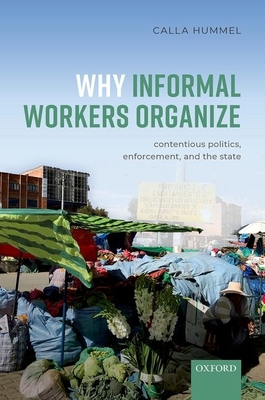
Why Informal Workers Organize : Contentious Politics, Enforcement, and the State
by
Calla Hummel
Book Details
Format
Hardback
ISBN-10
0192847813
ISBN-13
9780192847812
Publisher
Oxford University Press
Imprint
Oxford University Press
Country of Manufacture
GB
Country of Publication
GB
Publication Date
Nov 15th, 2021
Print length
222 Pages
Weight
488 grams
Dimensions
24.10 x 16.50 x 1.80 cms
Product Classification:
Sociology: work & labourSociology: work and labourComparative politics
KSh 18,050.00
Currently unavailable
0 in stock
Delivery Location
Delivery fee: Select location
Secure
Quality
Fast
This book examines the organization of informal workers across the globe, and the differing degrees to which they vary. The reality of informal work described in this book is supported by surveys in 60 countries, over 150 interviews with informal workers in Latin America, ethnographic data, and administrative data.
Informal workers make up over two billion workers or about 50% of the global workforce. Surprisingly, scholars know little about informal workers'' political or civil society participation. An informal worker is anyone who holds a job and who does not pay taxes on taxable earnings, does not hold a license for their work when one is required, or is not part of a mandatory social security system. For decades, researchers argued that informal workers rarely organized or participated in civil society and politics. However, millions of informal workers around the world start and join unions. Why do informal workers organize? In countries like Bolivia, informal workers such as street vendors, fortune tellers, witches, clowns, gravestone cleaners, sex workers, domestic workers, and shoe shiners come together in powerful unions. In South Africa, South Korea, and India, national informal worker organizations represent millions of citizens. The data in this book finds that informal workers organize in nearly every country for which data exists, but to varying degrees. This raises a related question: Why do informal workers organize in some places more than others? The reality of informal work described in this book and supported by surveys in 60 countries, over 150 interviews with informal workers in Bolivia and Brazil, ethnographic data from multiple cities, and administrative data upends the conventional wisdom on the informal sector. The contrast between scholarly expectations and emerging data underpin the central argument of the book: Informal workers organize where state officials encourage them to.
Get Why Informal Workers Organize by Calla Hummel at the best price and quality guaranteed only at Werezi Africa's largest book ecommerce store. The book was published by Oxford University Press and it has 222 pages.
Customers Who Bought This Also Bought

What Should I Do With My Life?
KSh 3,400.00

The Reverse Centaur's Guide to Life After AI
KSh 3,050.00

The Unfair Advantage
KSh 2,000.00

Chokepoint Capitalism
KSh 2,000.00
Making Africa Work
KSh 4,500.00
Faces of Precarity – Critical Perspectives on Work , Subjectivities and Struggles
KSh 13,150.00

Uncommon People
KSh 2,700.00
Hope and Danger in the New South City
KSh 7,500.00
Planet Work – Rethinking Labor and Leisure in the Anthropocene
KSh 22,300.00
Making Freedom Pay
KSh 5,750.00
Victory at Home
KSh 6,000.00

Glass Ceilings and 100-Hour Couples
KSh 5,050.00
