
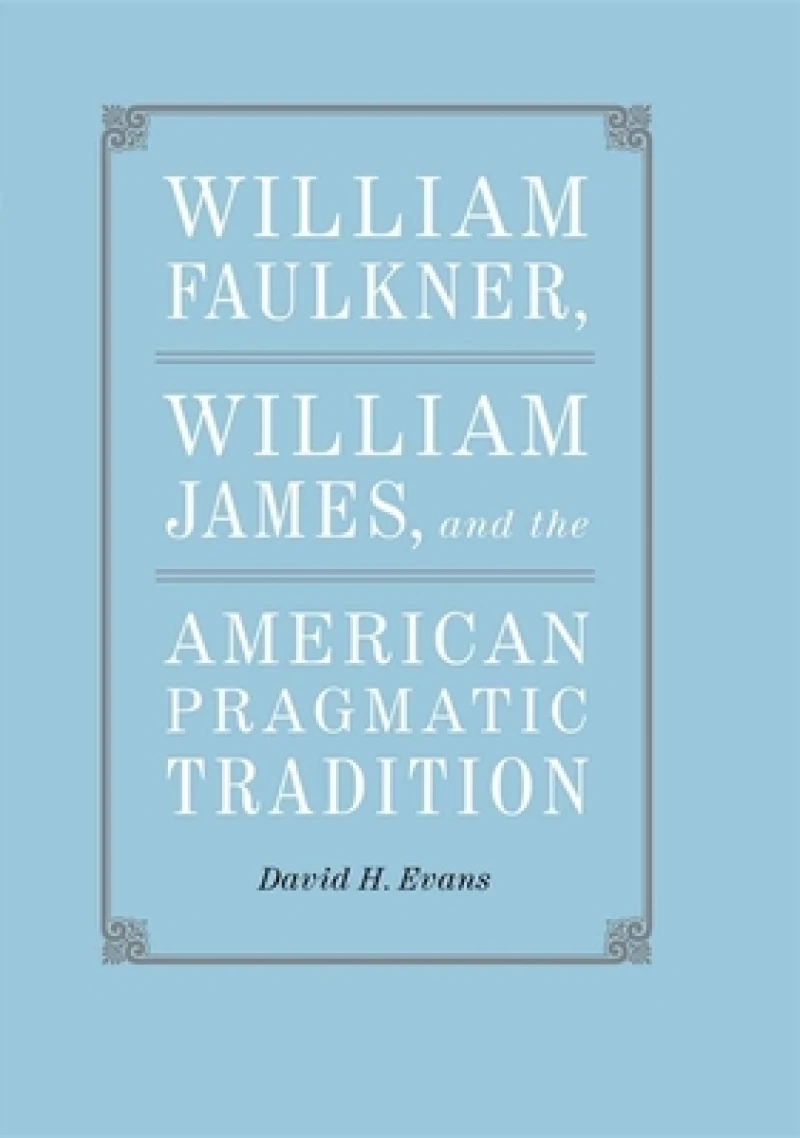
William Faulkner, William James, and the American Pragmatic Tradition
Book Details
Format
Hardback or Cased Book
Book Series
Southern Literary Studies
ISBN-10
0807133159
ISBN-13
9780807133156
Publisher
Louisiana State University Press
Imprint
Louisiana State University Press
Country of Manufacture
US
Country of Publication
GB
Publication Date
May 1st, 2008
Print length
304 Pages
Weight
333 grams
Dimensions
23.00 x 16.20 x 2.50 cms
Product Classification:
Literature: history & criticismLiterature: history and criticism
Ksh 7,200.00
Temporarily out of stock, due soon
0 in stock
Delivery Location
Delivery fee: Select location
Secure
Quality
Fast
In William Faulkner, William James, and the American Pragmatic Tradition, David H. Evans pairs the writings of America's most intellectually challenging modern novelist, William Faulkner, and the ideas of America's most revolutionary modern philosopher, William James. Though Faulkner was dubbed an idealist after World War II, Evans demonstrates that Faulkner's writing is deeply connected to the emergence of pragmatism as an intellectual doctrine and cultural force in the early twentieth century.
Tracing pragmatism to its very roots, Evans examines the nineteenth-century confidence man of antebellum literature as the original practitioner of the pragmatic principle that a belief can give rise to its own objects. He casts this figure as the missing link between Faulkner and James, giving him new prominence in the prehistory of pragmatism. Moving on to Jamesian pragmatism, Evans contends that James's central innovation was his ability to define truth in narrative terms - just as the confidence man did - as something subjective and personal that continually shapes reality, rather than a set of static, unchanging facts.
In subsequent chapters Evans offers detailed interpretations of three of Faulkner's most important novels, Absalom, Absalom!, Go Down, Moses, and The Hamlet, revealing that Faulkner, too, saw truth as fluid. By avoiding conclusion and finality, these three novels embody the pragmatic belief that life and the world are unstable and constantly evolving. Absalom, Absalom! stages a conflict of historical discourses that - much like the pragmatic concept of truth - can never be ultimately resolved. Evans shows us how Faulkner explores the conventional and arbitrary status of racial identity in Go Down, Moses, in a way that is strikingly similar to James's criticism of the concept of identity in general. Finally, Evans reads The Hamlet, a work that is often used to support the idea that Faulkner is opposed to modernity, as a depiction of a distinctly pragmatic and modern world.
With its creative coupling of James's philosophy and Faulkner's art, Evans's lively, engaging book makes a bold contribution to Faulkner studies and studies of southern literature.
Tracing pragmatism to its very roots, Evans examines the nineteenth-century confidence man of antebellum literature as the original practitioner of the pragmatic principle that a belief can give rise to its own objects. He casts this figure as the missing link between Faulkner and James, giving him new prominence in the prehistory of pragmatism. Moving on to Jamesian pragmatism, Evans contends that James's central innovation was his ability to define truth in narrative terms - just as the confidence man did - as something subjective and personal that continually shapes reality, rather than a set of static, unchanging facts.
In subsequent chapters Evans offers detailed interpretations of three of Faulkner's most important novels, Absalom, Absalom!, Go Down, Moses, and The Hamlet, revealing that Faulkner, too, saw truth as fluid. By avoiding conclusion and finality, these three novels embody the pragmatic belief that life and the world are unstable and constantly evolving. Absalom, Absalom! stages a conflict of historical discourses that - much like the pragmatic concept of truth - can never be ultimately resolved. Evans shows us how Faulkner explores the conventional and arbitrary status of racial identity in Go Down, Moses, in a way that is strikingly similar to James's criticism of the concept of identity in general. Finally, Evans reads The Hamlet, a work that is often used to support the idea that Faulkner is opposed to modernity, as a depiction of a distinctly pragmatic and modern world.
With its creative coupling of James's philosophy and Faulkner's art, Evans's lively, engaging book makes a bold contribution to Faulkner studies and studies of southern literature.
Get William Faulkner, William James, and the American Pragmatic Tradition by at the best price and quality guaranteed only at Werezi Africa's largest book ecommerce store. The book was published by Louisiana State University Press and it has pages.

