
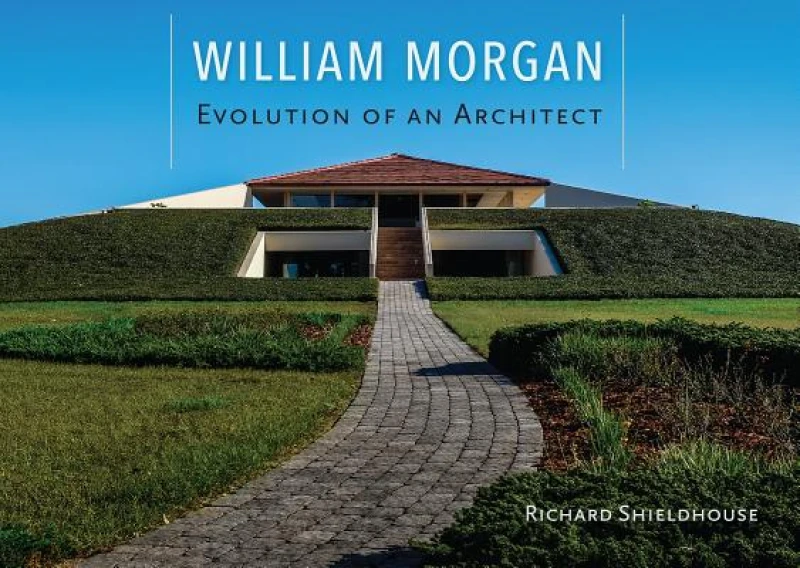
William Morgan : Evolution of an Architect
Book Details
Format
Hardback or Cased Book
ISBN-10
081305690X
ISBN-13
9780813056906
Publisher
University Press of Florida
Imprint
University Press of Florida
Country of Manufacture
US
Country of Publication
GB
Publication Date
Sep 25th, 2018
Print length
256 Pages
Weight
920 grams
Dimensions
18.80 x 26.30 x 2.40 cms
Ksh 8,000.00
Temporarily out of stock, due soon
0 in stock
Delivery Location
Delivery fee: Select location
Secure
Quality
Fast
William Morgan (1930-2016) was a bold, innovative, and highly imaginative architect known internationally for fusing ancient and modern styles and for his early championing of green design principles. This extensively illustrated book traces Morgan's life story and the development of his singular design vision.
William Morgan (1930–2016) was a bold, innovative, and highly imaginative architect known internationally for fusing ancient and modern styles and for his early championing of green design principles. This extensively illustrated book traces Morgan’s life story and the development of his singular design vision.
Exploring Morgan’s early influences, Richard Shieldhouse reveals the architect’s childhood familiarity with pre-Columbian village sites and introduces college mentors who encouraged his interest in both architecture and archaeology. During navy service in the Pacific, Morgan studied ancient structures in Guam as well as Frank Lloyd Wright’s design work in Japan. Later, his drive and discipline brought him into contact with leading architects such as Paul Rudolph at Harvard’s Graduate School of Design, a hotbed of modernism at the time. From there, Morgan struck out on his own in Jacksonville, Florida, to shape the course of architectural history.
This book tracks the evolution of Morgan’s guiding ideas?economy, efficiency, visual delight, imaginative use of everyday materials, and environmental sensitivity. His most famous designs are featured with photographs, drawings, and the architect’s own commentary. Structures such as the Dunehouses, a duplex built into the side of an oceanfront dune, represent Morgan’s commitment to earth architecture. His plans for police headquarters and other public buildings incorporate green roofs, stepped terraces, pyramid forms, and other elements inspired by aspects of prehistoric design.
Morgan was unique among architects for his interest in ancient North America and for blending a modern style characterized by its rejection of history with the design language of prehistory. Highlighting how his work has impacted many areas of architecture such as urban design, this book celebrates Morgan’s continuing legacy.
Exploring Morgan’s early influences, Richard Shieldhouse reveals the architect’s childhood familiarity with pre-Columbian village sites and introduces college mentors who encouraged his interest in both architecture and archaeology. During navy service in the Pacific, Morgan studied ancient structures in Guam as well as Frank Lloyd Wright’s design work in Japan. Later, his drive and discipline brought him into contact with leading architects such as Paul Rudolph at Harvard’s Graduate School of Design, a hotbed of modernism at the time. From there, Morgan struck out on his own in Jacksonville, Florida, to shape the course of architectural history.
This book tracks the evolution of Morgan’s guiding ideas?economy, efficiency, visual delight, imaginative use of everyday materials, and environmental sensitivity. His most famous designs are featured with photographs, drawings, and the architect’s own commentary. Structures such as the Dunehouses, a duplex built into the side of an oceanfront dune, represent Morgan’s commitment to earth architecture. His plans for police headquarters and other public buildings incorporate green roofs, stepped terraces, pyramid forms, and other elements inspired by aspects of prehistoric design.
Morgan was unique among architects for his interest in ancient North America and for blending a modern style characterized by its rejection of history with the design language of prehistory. Highlighting how his work has impacted many areas of architecture such as urban design, this book celebrates Morgan’s continuing legacy.
Get William Morgan by at the best price and quality guaranteed only at Werezi Africa's largest book ecommerce store. The book was published by University Press of Florida and it has pages.

