
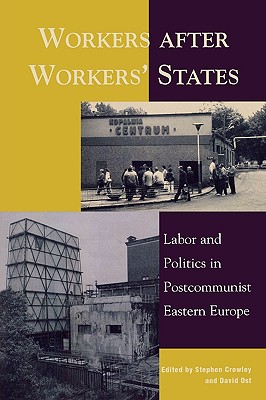
Workers after Workers'' States : Labor and Politics in Postcommunist Eastern Europe
Book Details
Format
Paperback / softback
ISBN-10
0742509990
ISBN-13
9780742509993
Publisher
Bloomsbury Publishing Plc
Imprint
Rowman & Littlefield
Country of Manufacture
GB
Country of Publication
GB
Publication Date
Sep 19th, 2001
Print length
256 Pages
Weight
370 grams
Dimensions
15.20 x 22.80 x 2.40 cms
Product Classification:
Sociology: work & labourSociology: work and labourPolitics & governmentPolitics and government
KSh 9,000.00
Currently unavailable
0 in stock
Delivery Location
Delivery fee: Select location
Secure
Quality
Fast
Why, given political freedom coupled with adverse economic change, has labour been so quiscent since the fall of communism in Eastern Europe? Through the use of case studies, this text explores the extent of these weaknesses and the relationship between labour and politcs in these countries.
After decades as the official ''ruling class'' of ostensible ''workers'' states,'' labor in Eastern Europe has fallen dramatically. Although the painful consequences of market transformation have hit workers hardest of all, protests have been surprisingly few and ineffective. More than ten years after the start of the transition, trade unions are among the weakest institutions of postcommunist society, unable to influence policymaking or secure material rewards for workers. Why, given unprecedented political freedoms coupled with such adverse economic change, has labor been so quiescent since the fall of communism in Eastern Europe? And what are the political consequences of that weakness for societies trying to build lasting democracies? This book, through the use of comparative case studies, explores the causes, extent, significance, and implications of this weakness. The ten cases-Bulgaria, Croatia, the Czech Republic, Hungary, Poland, Romania, Russia, Serbia, Slovakia, and Ukraine-focus on the status of trade unions and the relationship between labor and politics in each country. Comprising a full array of postcommunist societies, these countries represent a wide variation in labor institutions, political experiences, and economic outcomes. In their introduction and conclusion the editors consider structural, sociological, and ideational explanations for labor decline in the postcommunist era and assess the impact of that weakness on the consolidation of democracy in the region.
Get Workers after Workers'' States by David Ost at the best price and quality guaranteed only at Werezi Africa's largest book ecommerce store. The book was published by Bloomsbury Publishing Plc and it has 256 pages.
Customers Who Bought This Also Bought

What Should I Do With My Life?
KSh 3,400.00

The Reverse Centaur's Guide to Life After AI
KSh 3,050.00

The Unfair Advantage
KSh 2,000.00

Chokepoint Capitalism
KSh 2,000.00

Making Africa Work
KSh 4,500.00

Faces of Precarity – Critical Perspectives on Work , Subjectivities and Struggles
KSh 13,150.00

Uncommon People
KSh 2,700.00
Hope and Danger in the New South City
KSh 7,500.00

Planet Work – Rethinking Labor and Leisure in the Anthropocene
KSh 22,300.00

Making Freedom Pay
KSh 5,750.00

Victory at Home
KSh 6,000.00

Glass Ceilings and 100-Hour Couples
KSh 5,050.00
