

Workholder Devices : Design and Calculations
Book Details
Format
Paperback / softback
ISBN-10
0831136952
ISBN-13
9780831136956
Publisher
Industrial Press
Imprint
Industrial Press
Country of Manufacture
GB
Country of Publication
GB
Publication Date
Sep 30th, 2024
Print length
384 Pages
KSh 13,500.00
Re-Printing
0 in stock
Delivery Location
Delivery fee: Select location
Secure
Quality
Fast
Advancements in the fields of mechanization and automation have led to large strides forward for the entire manufacturing industry. Various products, ranging in size from cars to small circuit components, are made through automated procedures in manufacturing facilities. These processes help improve efficiency, save on labor costs, and reduce the occurrences of defective products, improving company growth and product quality.
A common feature of automated processes is the need for the item being worked on to be held firmly in place while work is being done on itworkholding. Workholders help improve the economy of production by creating smooth operational processes and helping to facilitate quick transitions from one work station to another. This simplifies and streamlines the entire mounting parts operation.
Manufacturing workholders use many different methods to hold the parts securely, including hydraulic, electric, pneumatic, and mechanical holders, depending on the application. Workholding devices are regularly referred to as jigs and fixtures, and are often used interchangeably. A fixture secures the workpiece and allows the tool (but does not guide it) to move relative to the workpiece, while a jig holds and locates the workpiece and actually guides the tool.
Workholder Devices presents the fundamentals of workholders design for machining and welding operations with their relevant applications, so readers can clearly assess the capabilities, limitations, potentials, and competitive aspects of each of these devices. The author shows how dynamic workholders are subject to constant change, improvement, and innovation.
Unique FeaturesA common feature of automated processes is the need for the item being worked on to be held firmly in place while work is being done on itworkholding. Workholders help improve the economy of production by creating smooth operational processes and helping to facilitate quick transitions from one work station to another. This simplifies and streamlines the entire mounting parts operation.
Manufacturing workholders use many different methods to hold the parts securely, including hydraulic, electric, pneumatic, and mechanical holders, depending on the application. Workholding devices are regularly referred to as jigs and fixtures, and are often used interchangeably. A fixture secures the workpiece and allows the tool (but does not guide it) to move relative to the workpiece, while a jig holds and locates the workpiece and actually guides the tool.
Workholder Devices presents the fundamentals of workholders design for machining and welding operations with their relevant applications, so readers can clearly assess the capabilities, limitations, potentials, and competitive aspects of each of these devices. The author shows how dynamic workholders are subject to constant change, improvement, and innovation.
- Contains more than 180 illustrations, numerous calculations, tables, and essential appendices.
- Special attention is paid to modular systems, clamping devices, and clamping force calculation.
- Perfect for students of manufacturing engineering, process engineers, design engineers and drafters, as well as quality control and maintenance and reliability managers and technicians.
Get Workholder Devices by Vukota Boljanovic at the best price and quality guaranteed only at Werezi Africa's largest book ecommerce store. The book was published by Industrial Press and it has 384 pages.
Customers Who Bought This Also Bought

The Design of Everyday Things 2e
KSh 4,500.00

Dressing Barbie
KSh 3,750.00

Bookshelf
KSh 3,050.00

Thermomechanical Pulp
KSh 16,750.00

Mathematical Algorithms for Educational Data Classification
KSh 18,700.00

Intelligent Manufacturing Systems and Industry 5.0
KSh 18,700.00

Design for the Unthinkable World
KSh 8,650.00

Applied Reliability, Usability, and Quality for Engineers
KSh 26,300.00

Polysaccharide-based Fibers and Composites
KSh 8,100.00

Anthropometry
KSh 10,450.00

The Package Design Book 7
KSh 11,850.00

Brand Experience & Trade Fair Design Annual 2026
KSh 17,300.00
More by Vukota Boljanovic
Sheet Metal Stamping Dies
KSh 10,800.00
Sheet Metal Forming Processes and Die Design
KSh 13,850.00
Sheet Metal Stamping Dies: Die Design and Die Making Practice + 4090 Sheet Metal / HVAC Pro Calc Calculator (Set)
KSh 18,000.00
Die Design Fundamentals
KSh 11,250.00
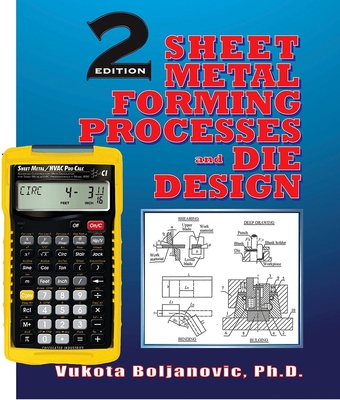
Sheet Metal Forming Processes and Die Design, 2e + 4090 Sheet Metal / HVAC Pro Calc Calculator (Set)
KSh 23,400.00
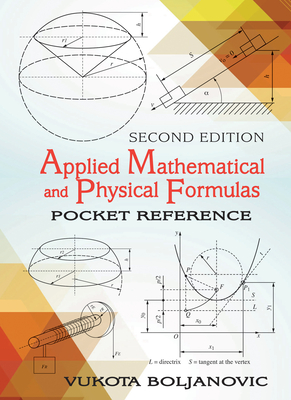
Applied Mathematical and Physical Formulas
KSh 9,000.00
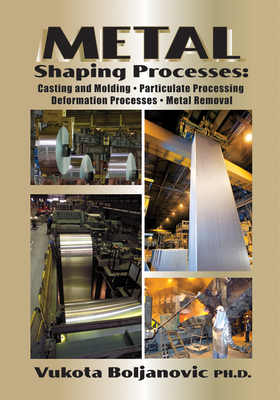
Metal Shaping Processes
KSh 13,500.00
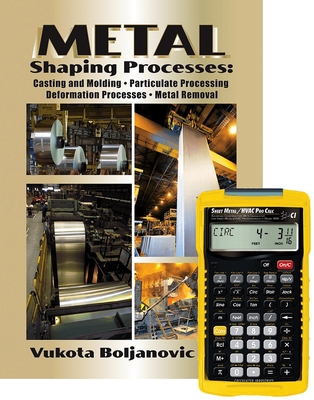
Metal Shaping Processes: Casting and Molding; Particulate Processing; Deformation Processes; And Metal Removal + 4090 Sheet Metal / HVAC Pro Calc Calculator (Set)
KSh 23,400.00
