
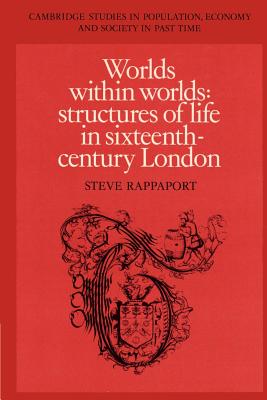
Worlds Within Worlds : Structures of Life in Sixteenth-Century London
Book Details
Format
Paperback / softback
ISBN-10
052189221X
ISBN-13
9780521892216
Publisher
Cambridge University Press
Imprint
Cambridge University Press
Country of Manufacture
GB
Country of Publication
GB
Publication Date
Apr 4th, 2002
Print length
468 Pages
Weight
704 grams
Dimensions
23.00 x 15.20 x 2.90 cms
KSh 6,700.00
Currently unavailable
0 in stock
Delivery Location
Delivery fee: Select location
Secure
Quality
Fast
Worlds Within Worlds combines sophisticated quantitative analysis with vivid empirical detail, and mounts a major challenge to much current thinking about urban life in early modern Britain.
The enormous growth of London during the early modern period brought with it major social problems, yet, as Steve Rappaport demonstrates in this innovative study, Tudor London was essentially a stable society, subject to stress but never seriously threatened by widespread popular unrest or other forms of instability. Professor Rappaport looks once again at the nature, causes, and effects of the principal threats to the capital's stability in the sixteenth century - the threefold increase in population, the economic impact of such demographic expansion, the substantial rise in prices and the inequitable distribution of wealth and power - and concludes that historians have hitherto exaggerated the severity of such problems and over-simplified their effects. Professor Rappaport's researches suggest that the institutional superstructure of the capital was more adaptable, its small social organisations more resilient, and opportunities for social mobility far greater than many historians have acknowledged. Worlds Within Worlds combines sophisticated quantitative analysis with vivid empirical detail, and mounts a major challenge to much current thinking about urban life in early modern Britain.
Get Worlds Within Worlds by Steve Rappaport at the best price and quality guaranteed only at Werezi Africa's largest book ecommerce store. The book was published by Cambridge University Press and it has 468 pages.
Customers Who Bought This Also Bought

Churchill
KSh 3,700.00

Difficult Women
KSh 2,350.00

Legacy of Violence
KSh 3,150.00
Agricola and the Germania
KSh 2,350.00

Empireland
KSh 2,150.00

The History of the Kings of Britain
KSh 2,350.00

Siege
KSh 2,000.00

Anarchy
KSh 2,700.00

What Matters in Jane Austen?
KSh 2,700.00
Unruly
KSh 2,150.00
Map Of A Nation
KSh 2,350.00

Black and British
KSh 2,350.00
