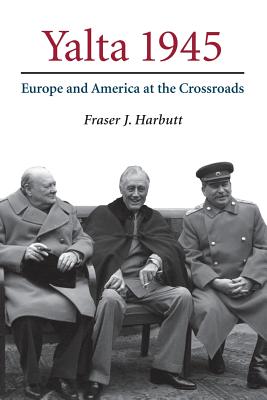
Yalta 1945 : Europe and America at the Crossroads
Book Details
Format
Paperback / softback
ISBN-10
0521673119
ISBN-13
9780521673112
Publisher
Cambridge University Press
Imprint
Cambridge University Press
Country of Manufacture
GB
Country of Publication
GB
Publication Date
May 1st, 2014
Print length
470 Pages
Weight
744 grams
Dimensions
23.50 x 16.20 x 2.90 cms
Product Classification:
General & world historyEuropean historyHistory of the Americas20th century history: c 1900 to c 2000Postwar 20th century history, from c 1945 to c 2000The Cold WarSecond World WarDiplomacyHistoryGeneral and world historyEuropean historyHistory of the AmericasCold wars and proxy conflictsSecond World War
KSh 6,550.00
Currently unavailable
0 in stock
Delivery Location
Delivery fee: Select location
Secure
Quality
Fast
This book examines Allied diplomacy from 1941 to 1946, challenging Americocentric views and highlighting the significance of Europe's diplomatic role. Harbutt argues that the Yalta conference of February 1945 was a pivotal moment that signaled a shift from a pre-existing 'Europe/America' framework to the 'East/West' conception that led to the Cold War.
This revisionist study of Allied diplomacy from 1941 to 1946 challenges Americocentric views of the period and highlights Europe's neglected role. Fraser J. Harbutt, drawing on international sources, shows that in planning for the future Churchill, Roosevelt, Stalin, and others self-consciously operated into 1945, not on 'East/West' lines but within a 'Europe/America' political framework characterized by the plausible prospect of Anglo-Russian collaboration and persisting American detachment. Harbutt then explains the destabilizing transformation around the time of the pivotal Yalta conference of February 1945, when a sudden series of provocative initiatives, manipulations, and miscues interacted with events to produce the breakdown of European solidarity and the Anglo-Soviet nexus, an evolving Anglo-American alignment, and new tensions that led finally to the Cold War. This fresh perspective, stressing structural, geopolitical, and traditional impulses and constraints, raises important new questions about the enduringly controversial transition from World War II to a cold war that no statesman wanted.
Get Yalta 1945 by Fraser J. Harbutt at the best price and quality guaranteed only at Werezi Africa's largest book ecommerce store. The book was published by Cambridge University Press and it has 470 pages.
Customers Who Bought This Also Bought
A Modern History of the Somali
KSh 5,300.00

Sapiens
KSh 2,350.00

Rise Fall Great Powers
KSh 3,050.00

Legacy of Violence
KSh 3,150.00

Chip War
KSh 2,000.00
Covering Islam
KSh 2,350.00

They Came Before Columbus
KSh 3,400.00

Hiroshima
KSh 2,000.00

Guns, Germs and Steel
KSh 2,400.00

Silk Roads
KSh 3,050.00

Empire
KSh 2,700.00

Strategy
KSh 4,350.00