
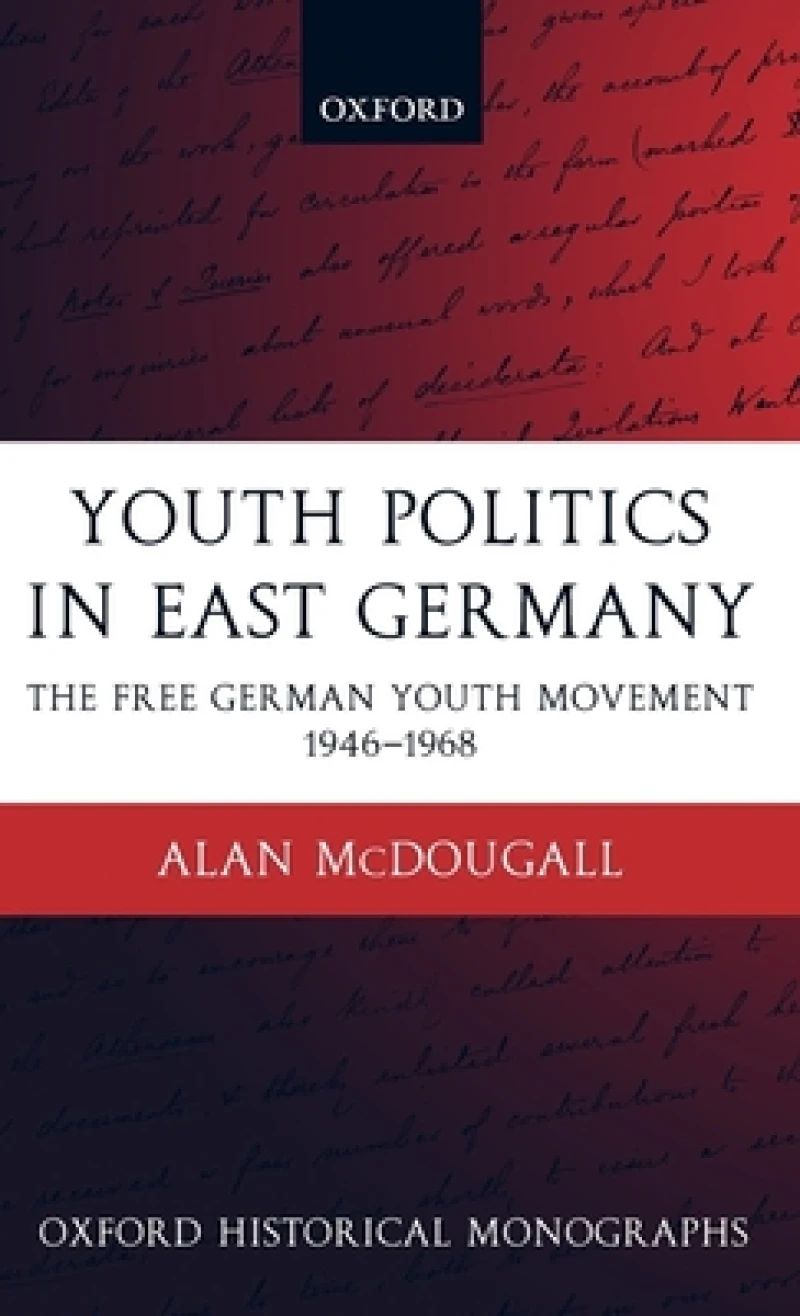
Youth Politics in East Germany : The Free German Youth Movement 1946-1968
Book Details
Format
Hardback or Cased Book
Book Series
Oxford Historical Monographs
ISBN-10
0199276277
ISBN-13
9780199276271
Publisher
Oxford University Press
Imprint
Oxford University Press
Country of Manufacture
GB
Country of Publication
GB
Publication Date
Dec 9th, 2004
Print length
280 Pages
Weight
453 grams
Dimensions
22.40 x 14.40 x 2.00 cms
Ksh 22,450.00
Manufactured on Demand
0 in stock
Delivery Location
Delivery fee: Select location
Secure
Quality
Fast
In East Germany, during the 1950s and 1960s young people were a constant problem for the communist authorities - and in particular for the communist youth organization, the Free German Youth (FDJ). This book provides a study of the often troubled relationship between the FDJ and East German youth during this important period.
In communist East Germany young people constituted the social group for whom the ruling authorities had the highest hopes - and in whom they were most frequently and bitterly disappointed. In Youth Politics in East Germany the author has undertaken a pioneering study of the East German communist youth organization, the Free German Youth (FDJ), and the young people that it tried, often in vain, to enthuse and control. Utilizing a wide range of primary sources, Dr McDougall focuses upon East German youth during five ''crisis points'' in the GDR''s early history, beginning with the June 1953 uprising and concluding with the impact of the Czechoslovakian Prague Spring in 1968. In the process, he provides a political and social history of East German youth within and beyond the framework of ''organized'' youth life. Important events in East German youth politics are analysed in detail, alongside the subversive role of Western youth culture in the GDR, particularly during the 1960s when ''hot'' music by groups such as The Beatles penetrated the Iron Curtain. This book has important wider implications in the thriving field of GDR studies. Dr McDougall contends that there is little to be gained from viewing the history of East German youth politics - and that of the GDR more generally - through the narrow prism of totalitarian theory, with its heavy emphasis on the role of repression and Soviet military power in maintaining dictatorial rule. The relationship between rulers and ruled in the GDR was in fact based upon the dual precepts of coercion and consent, according to which the communist authorities sought both to appease and control the East German population. This model helps to explain the nature of youth dissent - both its proliferation and ultimate limitations - in the GDR. Despite an expanding secret police apparatus, youth dissent in the GDR was far more extensive than many Western scholars assumed in the Cold War era. Though much of this dissent was limited in character and intent, especially after the June 1953 uprising, it undermined the GDR''s long-term stability - a fact reflected in the prominent role of former FDJ members in its collapse in 1989. By integrating social and political aspects at each stage of his study, Dr McDougall provides a valuable study of the East German regime.
Get Youth Politics in East Germany by at the best price and quality guaranteed only at Werezi Africa's largest book ecommerce store. The book was published by Oxford University Press and it has pages.

