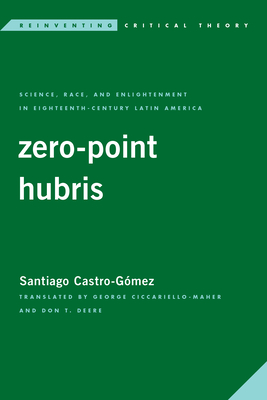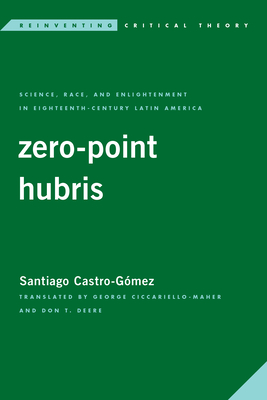
Zero-Point Hubris : Science, Race, and Enlightenment in Eighteenth-Century Latin America
Book Details
Format
Hardback or Cased Book
ISBN-10
178661376X
ISBN-13
9781786613769
Publisher
Bloomsbury Publishing PLC
Imprint
Rowman & Littlefield International
Country of Manufacture
GB
Country of Publication
GB
Publication Date
Dec 27th, 2021
Print length
330 Pages
Weight
689 grams
Dimensions
23.90 x 15.90 x 2.70 cms
Product Classification:
Colonialism & imperialismPhilosophyHistory of ideasPolitics & government
Ksh 23,350.00
Manufactured on Demand
Delivery in 29 days
Delivery Location
Delivery fee: Select location
Delivery in 29 days
Secure
Quality
Fast
Operating within the framework of postcolonial studies and decolonial theory, this important work starts from the assumption that the violence exercised by European colonialism was not only physical and economic, but also ‘epistemic’. Santiago Castro-Gómez argues that toward the end of the 18th century, this epistemic violence of the Spanish Empire assumed a specific form: zero-point hubris. The ‘many forms of knowing’ were integrated into a chronological hierarchy in which scientific-enlightened knowledge appears at the highest point on the cognitive scale, while all other epistemes are seen as constituting its past. Enlightened criollo thinkers did not hesitate to situate the blacks, Indians, and mestizos of New Granada in the lowest position on this cognitive scale. Castro-Gómez argues that in the colonial periphery of the Spanish Americas, Enlightenment constituted not only the position of epistemic distance separating science from all other knowledges, but also the position of ethnic distance separating the criollos from the ‘castes’. Epistemic violence—and not only physical violence—is thereby found at the very origin of Colombian nationality.
Get Zero-Point Hubris by at the best price and quality guaranteed only at Werezi Africa's largest book ecommerce store. The book was published by Bloomsbury Publishing PLC and it has pages.