
Cart 0
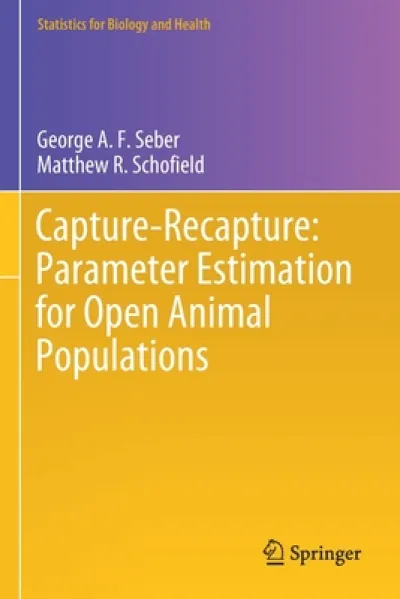
Capture-Recapture: Parameter Estimation for Open Animal Populations
Click to zoom

Share this book

Capture-Recapture: Parameter Estimation for Open Animal Populations

2019 ed.

Book Details

Format Paperback / Softback
ISBN-10 3030181898
ISBN-13 9783030181895
Edition 2019 ed.
Publisher Springer Nature Switzerland AG
Imprint Springer Nature Switzerland AG
Country of Manufacture GB
Country of Publication GB
Publication Date Aug 26th, 2020
Print length 663 Pages
Ksh 14,400.00
Werezi Extended Catalogue Delivery in 28 days

Delivery Location

Delivery fee: Select location

Delivery in 28 days

Secure
Quality
Fast
This  comprehensive book, rich with applications,  offers a quantitative framework for the analysis of the various capture-recapture models for open animal populations, while also addressing associated computational methods.  The state of our wildlife populations provides a litmus test for the state of our environment, especially in light of global warming and the increasing pollution of our land, seas, and air. In addition to monitoring our food resources such as fisheries, we need to protect endangered species from the effects of human activities (e.g. rhinos, whales, or encroachments on the habitat of orangutans). Pests must be be controlled, whether insects or viruses, and we need to cope with growing feral populations such as opossums, rabbits, and pigs. Accordingly, we need to obtain information about a given population’s dynamics, concerning e.g. mortality, birth, growth, breeding, sex, and migration, and determine whether the respective population is increasing , static, or declining. There are many methods for obtaining population information, but the most useful (and most work-intensive) is generically known as “capture-recapture,” where we mark or tag a representative sample of individuals from the population and follow that sample over time using recaptures, resightings, or dead recoveries. Marks can be natural, such as stripes, fin profiles, and even DNA; or artificial, such as spots on insects. Attached tags can, for example, be simple bands or streamers, or more sophisticated variants such as radio and sonic transmitters. To estimate population parameters, sophisticated and complex mathematical models have been devised on the basis of recapture information and computer packages. This book addresses the analysis of such models. It is primarily intended for ecologists and wildlife managers who wish to apply the methods to the types of problems discussed above, though it will also benefit researchers and graduate students in ecology. Familiarity with basic statistical concepts is essential.

This  comprehensive book, rich with applications,  offers a quantitative framework for the analysis of the various capture-recapture models for open animal populations, while also addressing associated computational methods.

 The state of our wildlife populations provides a litmus test for the state of our environment, especially in light of global warming and the increasing pollution of our land, seas, and air. In addition to monitoring our food resources such as fisheries, we need to protect endangered species from the effects of human activities (e.g. rhinos, whales, or encroachments on the habitat of orangutans). Pests must be be controlled, whether insects or viruses, and we need to cope with growing feral populations such as opossums, rabbits, and pigs.

Accordingly, we need to obtain information about a given population''s dynamics, concerning e.g. mortality, birth, growth, breeding, sex, and migration, and determine whether the respective population is increasing , static, or declining. There are many methods for obtaining population information, but the most useful (and most work-intensive) is generically known as "capture-recapture," where we mark or tag a representative sample of individuals from the population and follow that sample over time using recaptures, resightings, or dead recoveries. Marks can be natural, such as stripes, fin profiles, and even DNA; or artificial, such as spots on insects. Attached tags can, for example, be simple bands or streamers, or more sophisticated variants such as radio and sonic transmitters.

To estimate population parameters, sophisticated and complex mathematical models have been devised on the basis of recapture information and computer packages. This book addresses the analysis of such models. It is primarily intended for ecologists and wildlife managers who wish to apply the methods to the types of problems discussed above, though it will also benefit researchers and graduate students in ecology. Familiarity with basic statistical concepts is essential.


Get Capture-Recapture: Parameter Estimation for Open Animal Populations by at the best price and quality guaranteed only at Werezi Africa's largest book ecommerce store. The book was published by Springer Nature Switzerland AG and it has pages.


Mind, Body, & Spirit

Price

Ksh 14,400.00

Shopping Cart

Africa largest book store

Sub Total:
Ebooks

Digital Library
Coming Soon

Our digital collection is currently being curated to ensure the best possible reading experience on Werezi. We'll be launching our Ebooks platform shortly.